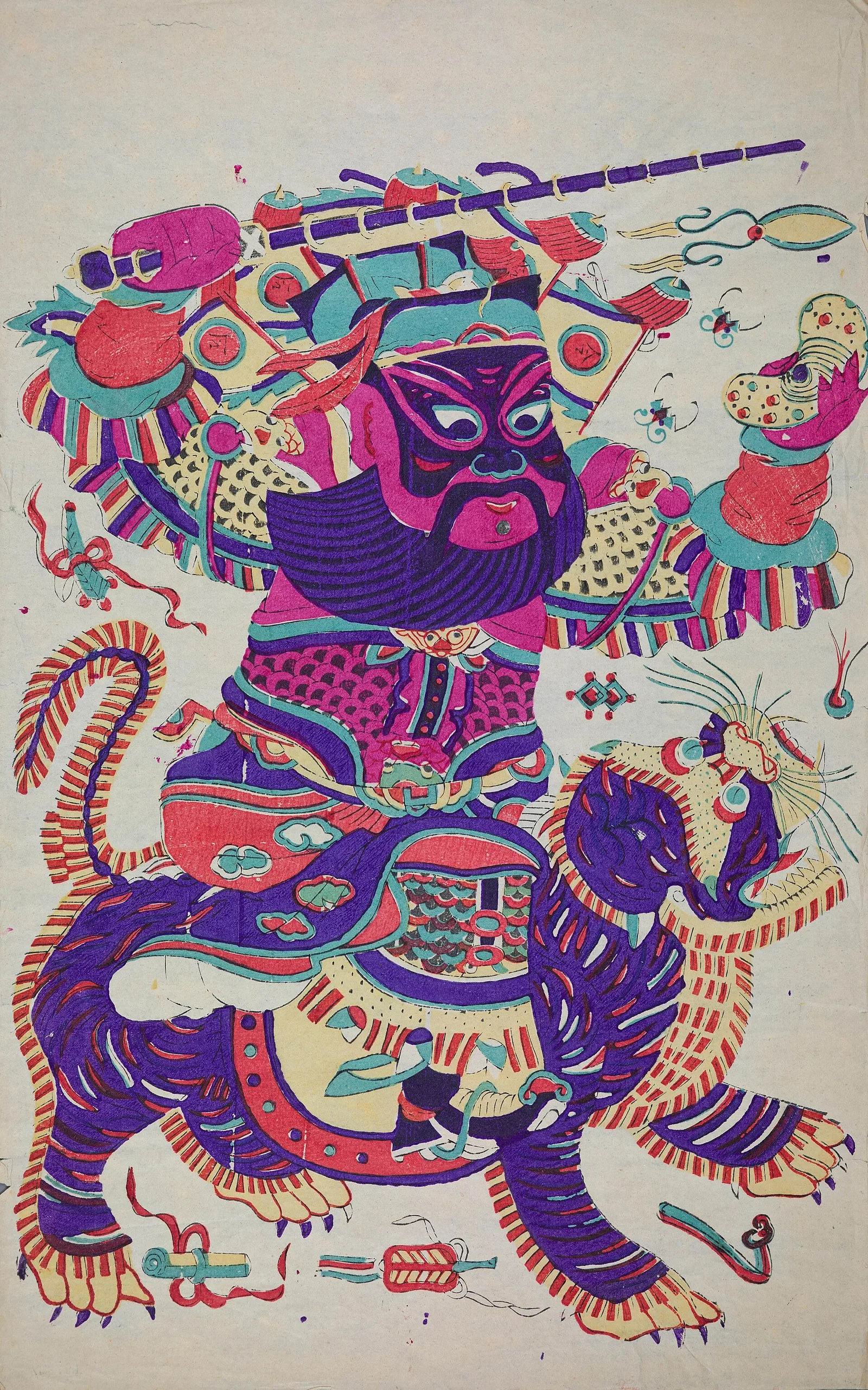
Taohuawu is a neighbourhood in north Suzhou, and for more than four centuries it has given its name to a style of woodblock New Year print. These were not fine-art prints for collectors. They were household objects, pasted on doors and walls at the new year to invite good fortune and keep bad luck out.
The prints are bold, flat and colourful, with a visual language that owes more to opera and folk religion than to literati painting. Door gods glare from the page. A plump child holds a carp. A bat flutters above a peony. Every image is a pun, a blessing or a threat. Once you learn the code, the prints are endlessly readable.
What a New Year print is
A New Year print was a disposable object with a serious job. It marked the change of the year, protected the household, invited prosperity and expressed hopes for children, harvest, examination success or business. Prints were pasted on doors, kitchen walls, beds and shop counters. They were replaced annually, which is why early examples are rare.
The subjects fall into a few broad groups: door gods and protective figures; the kitchen god, who reported on the household; auspicious symbols for wealth, peace and many sons; scenes from opera and literature; and satirical or news-based images. The Taohuawu style is known for its strong outlines, saturated colours and crowded, energetic compositions.
The Gusu edition
In the Kangxi and Qianlong periods, Suzhou produced a refined type of New Year print that collectors call the Gusu edition. These prints were finer than the usual folk product: more delicate carving, more complex colour printing, sometimes Western-style perspective. They were exported to Japan and Europe, where they were collected as examples of Chinese popular art.
The Gusu edition shows Suzhou’s double character. The city had a highly sophisticated literati culture and a vigorous commercial print industry. The same urban economy that supported Wu School painting also produced cheap images for ordinary households. The two were not sealed off from each other.
How to read a print
Taohuawu prints are full of visual puns. A bat sounds like the word for blessing. A fish sounds like surplus. A vase sounds like peace. A pomegranate suggests many sons. A peony stands for wealth and honour. A lion offers protection. A magpie signals joy. Once you know the vocabulary, a crowded print becomes a sentence.
- Door gods. Fierce military figures who guard the entrance and keep out evil spirits.
- The kitchen god. A domestic deity who observes the household and reports to heaven at the new year.
- Auspicious children. Plump babies and boys at play, expressing hopes for family continuity.
- Opera scenes. Moments from popular stories, recognisable to a wide audience.
- Wealth and harvest. Grain, gold, fish, treasure and the gods who dispense them.
The colours are not realistic. They are symbolic and decorative: strong reds, greens, yellows, purples and blacks, printed in flat layers. The registration of the blocks is part of the aesthetic. A slight misalignment is a sign of hand printing, not a defect.
The making
A print begins with a design, which is transferred to a woodblock. The carver cuts away the negative space, leaving the lines and areas to be printed. Each colour usually requires a separate block. The printer registers the paper against the blocks, applies ink and presses. A complex print may require five or more blocks and several passes through the press.
The craft was added to China’s first national intangible cultural heritage list in 2006. It survives through a small number of inheritors, museums and workshops. Some studios offer printing experiences, which are a good way to understand the process even if you do not buy anything.
Where to see and buy
The Taohuawu print museum and its experience hall are the natural starting point. The museum grew out of the old print workshop tradition, and the experience hall on Taohuawu Street shows the process and sells modern prints. The Suzhou Art Museum also holds exhibitions of Gusu edition prints and contemporary work; check what is on before you go.
For buying, distinguish between an original print, a modern reproduction and a digitally printed souvenir. An original is printed from woodblocks on paper, usually in a limited edition, and may be signed and numbered. A reproduction is a copy of an old image, often printed offset. A souvenir may be neither. Ask directly, and look at the surface: a woodblock print has ink sitting on the paper, with slight variation and texture.
Prices vary widely. A small modern print may cost a few hundred yuan; a large, multi-colour limited edition more. Antique Gusu editions are rare and expensive, and the market is full of reproductions. If you are buying an antique, work with a reputable dealer and get a condition report.
Why it matters
Taohuawu prints are the other Suzhou: not the scholar’s studio but the kitchen wall, not the garden but the shopfront, not ink on paper but colour on cheap paper. They are a reminder that heritage is not only the taste of the elite. It is also the visual world of ordinary people, made with skill and used with joy.
If you have time for only one craft museum in Suzhou, the embroidery and silk collections may win. But if you want to understand the city’s popular imagination, spend an hour with the New Year prints. They are louder, funnier and stranger than the gardens.
Questions people ask
What are Taohuawu prints?
Taohuawu prints are woodblock New Year prints from the Taohuawu area of Suzhou. They were pasted on doors and walls at the new year to bring good luck and protection. The tradition is more than 400 years old.
Are Taohuawu prints valuable?
Antique Gusu edition prints are rare and can be valuable. Modern limited-edition prints are affordable. Most souvenir-shop copies are reproductions with little resale value. Buy for the image, not as an investment, unless you have expert advice.
Where can I see Taohuawu prints in Suzhou?
The Taohuawu print museum and experience hall, and the Suzhou Art Museum, are the best places. Temporary exhibitions are common, so check before you go.
Can I make a Taohuawu print myself?
Some studios and the Taohuawu experience hall offer printing workshops. They are usually short sessions rather than a full course. Ask about language and booking in advance.