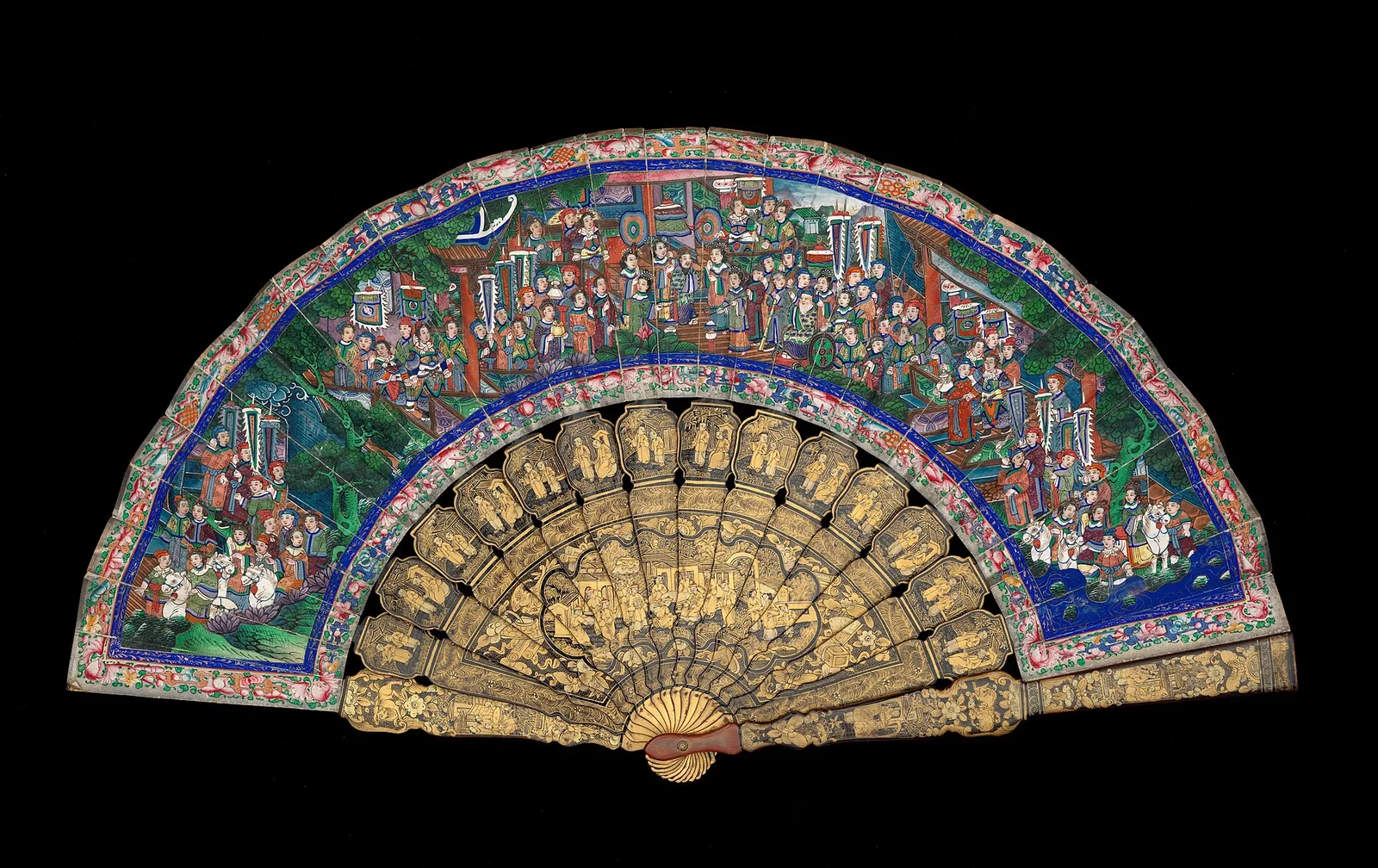
Suzhou is known for “elegant fans” — a family of objects that includes folding fans, sandalwood fans and round silk fans. They share a city and a craft tradition, but they are made in different ways and used for different purposes. The first step to buying well is to know which one you are looking at.
A fan is a collaboration. The fan-maker makes the frame or the ribs; the painter or calligrapher decorates the leaf; the assembler puts the parts together so that they open and close smoothly. A good fan is judged as a whole object, not as a picture with a handle.
Three fans
| Type | Material | Character |
|---|---|---|
| Folding fan | Bamboo or wood ribs, paper or silk leaf | Painted or calligraphed; opens and closes |
| Sandalwood fan | Sandalwood ribs and leaf | Openwork carving, pyrography, aromatic |
| Round fan | Silk or paper leaf on a fixed frame | Painted; often associated with women |
The folding fan is the most familiar. It has two guards and a set of inner ribs, joined at a pivot. The leaf is folded between the ribs. The best ribs are made from bamboo, ebony or other hard woods, shaped and polished by hand. The leaf may be paper or silk, painted with a landscape, flowers, figures or calligraphy.
The sandalwood fan is a Suzhou speciality. It evolved from the folding fan in the late Qing and early twentieth century, and it is made from thin sheets of sandalwood carved with openwork patterns, sometimes combined with pyrography. It is aromatic, delicate and mainly decorative. As a distinct style, it is only about a century old, not an ancient tradition.
The round fan, also called a palace fan, has a fixed frame and a silk or paper leaf. It was already common in the Song dynasty, and it appears in paintings and poetry as an object of feminine elegance. The leaf is usually painted, sometimes embroidered or inlaid. It does not fold, so it is displayed or carried rather than tucked into a sleeve.
The folding fan
Suzhou became a centre of folding-fan production in the Ming dynasty. The city’s craftsmen supplied scholars, officials and merchants with fans that were both useful and expressive. A fan could carry a painting, a poem, a dedication or a status symbol. It was an accessory for the hand and a surface for the mind.
The leaf is the most visible part, but the ribs are the engineering. Good ribs are cut from mature bamboo or hardwood, shaped to taper evenly, and polished so that they slide without catching. The pivot should be tight enough to hold the fan open but smooth enough to open with one hand. If the fan feels stiff, loose or unbalanced, the painting will not save it.
A hand-painted fan may be signed by the artist. The painting and the calligraphy are often related: a landscape with a poem, a flower with a line of verse. The best fans were made for a specific recipient, with a dedication on the reverse. That personal element is part of what makes them collectible.
Sandalwood fans
Sandalwood fans are made from thin, fragrant sheets of wood. The design is cut through the wood with a fine saw, creating a lace-like pattern of figures, flowers, landscapes or geometric motifs. The surface may also be decorated with pyrography, a technique that burns fine brown lines into the wood.
The craft is associated with Suzhou’s late Qing and Republican-period workshops, and it became a significant export product in the twentieth century. A good sandalwood fan is lightweight, flexible and evenly carved. The scent should be natural and subtle, not perfumed. If the fan smells strongly of artificial fragrance, it may have been treated.
How to judge a fan
- Balance. Open the fan and hold it at the pivot. It should feel even, not heavy on one side.
- Ribs. Look for straight, evenly tapered ribs with smooth edges. Bamboo should show fine grain, not cracks.
- Leaf. Paper should be supple, not brittle. Silk should be clean and evenly stretched. Look for stains, foxing and repairs.
- Painting. Hand-painted work has variation in brushwork and colour. A print is flat and repetitive under a loupe.
- Signature and seals. A signature is not a guarantee of quality, but it is part of the object’s history. Learn the artist before paying a premium.
- Mechanism. Open and close the fan several times. It should move smoothly without grinding or wobbling.
Price follows the same logic. A printed souvenir fan may cost tens of yuan. A hand-painted fan with good ribs may cost several hundred to a few thousand. A fan by a recognised master, with a documented painting and a good frame, can cost far more. There is no fixed market; condition and provenance matter.
Where to see and buy
The Suzhou Museum West’s Suzhou Crafts Gallery displays fans alongside embroidery, kesi, Song brocade and furniture. It is the best place to see the range of the craft and to understand how a fan relates to the other decorative arts. The Suzhou Museum’s main collection may also have fans on display.
For buying, go to established fan shops or studio workshops rather than souvenir stalls. Ask whether the leaf is hand-painted, whether the ribs are bamboo or wood, and whether the fan is meant for use or display. A good shop will let you open and close the fan and will explain the materials. A shop that rushes you is selling a souvenir, not a fan.
If you want a usable fan, choose a simple bamboo folding fan with a sturdy leaf. If you want a collectible, buy one good piece with a signature and a story, and keep it out of sunlight. Do not buy a fan as an investment unless you know the artist and the market.
Care
Keep fans away from damp, direct sun and heat. Open them fully when displaying, or store them flat in a dry box. Do not leave a folding fan half-open for long periods; the leaf can develop a memory fold. Dust with a soft brush, not a damp cloth. If the leaf is torn, do not repair it with household tape; take it to a conservator.
Questions people ask
What are Suzhou fans?
Suzhou fans are a family of fans made in Suzhou, including folding fans, sandalwood fans and round silk fans. The fan-making technique is on China’s national intangible cultural heritage list (2006).
Are sandalwood fans old?
As a distinct Suzhou style, the sandalwood fan is about a century old, not an ancient tradition. It developed from the folding fan in the late Qing and early twentieth century.
How much should a Suzhou fan cost?
A printed souvenir may cost tens of yuan; a hand-painted fan with good ribs can cost hundreds to a few thousand; a masterwork with provenance can cost much more. Price depends on materials, handwork, artist and condition.
Can I use a folding fan?
Yes, if it is made for use. Open and close it gently, keep it dry, and avoid leaving it in direct sun. A delicate painted fan is better displayed than carried daily.