Suzhou is a big city with a small historic core. Most of what you want to see is inside the old town, where walking is the best way to get around. For everything else, the metro and DiDi are fast and cheap. You do not need to rent a car, and you should not.
Walking
The old town is flat and compact. The Humble Administrator’s Garden, the Suzhou Museum, Pingjiang Road and the Lion Grove are within 15 minutes of each other. The Lingering Garden is a bit further west, and Tiger Hill is north of the old town. Wear comfortable shoes; the stone lanes are uneven and slippery when wet.
Walking is also the point. The old town’s pleasure is in the lanes, the canal views, the doorways and the small shops. Do not rush between sights. Leave time to get lost.
Metro
The metro is clean, cheap and bilingual. Lines 1, 2, 3, 4, 5, 6, 7, 8 and 11 are in operation, with more under construction. Line 4 runs north–south through the old town and connects to Suzhou Railway Station. Line 2 connects Suzhou North Station with the old town and the railway station. Line 1 runs east–west and is useful for the new city.
Buy a single ticket from the machine or scan Alipay/WeChat at the gate. Fares are a few yuan. Trains run from about 6:00 to 23:00, but the last train varies by line. Check before a late dinner. The metro is the best way to reach Jinji Lake, the stations and the newer museums.
Taxis and DiDi
Taxis are cheap by Western standards, and DiDi is easy to use with the English app. A trip across the old town is usually 15–25 CNY; a trip to Jinji Lake or a station is 40–80 CNY. DiDi avoids the language problem: you enter the destination, the driver comes to you, and you pay in the app.
Taxis cannot always enter the narrow lanes. Set your pickup point on a main street and walk the last block. At train stations, use the official taxi rank or the DiDi pickup zone; ignore drivers who approach you inside the station.
Buses and bikes
The bus network is extensive but hard to use without Chinese. If you are comfortable with maps and translation, it is cheap and useful for short hops. Shared bikes are everywhere, but the old town’s lanes are crowded and cycling is not always pleasant. Use a bike for the new city or the canal paths, not for Pingjiang Road.
Boats
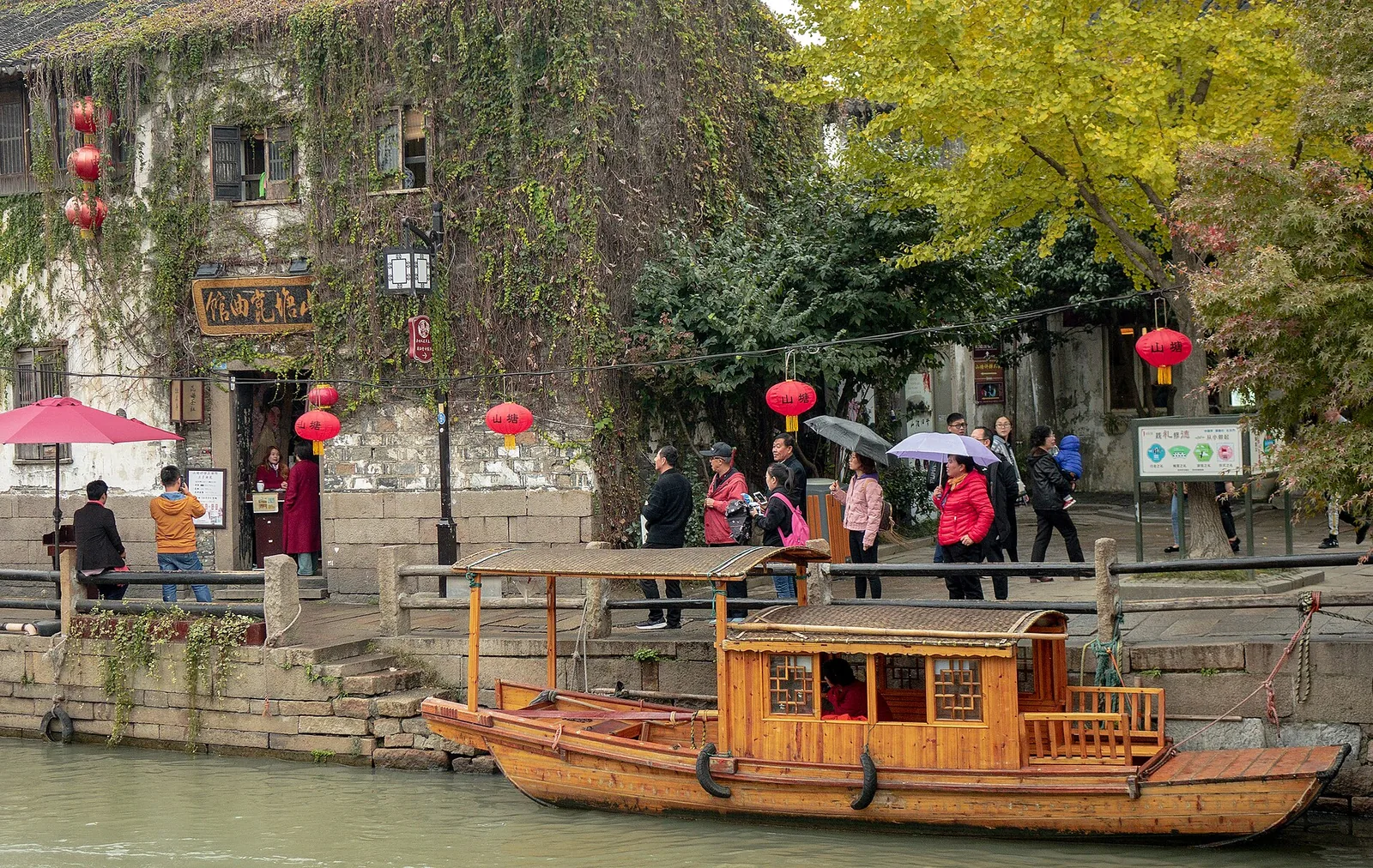
Canal boats are for atmosphere, not transport. The short tourist loops on Pingjiang Road and Shantang Street are pleasant, especially at dusk. The boat is not faster than walking and does not go far. Do it once, for the view from the water, and then walk.
For a longer boat trip, look for the Grand Canal or Panmen cruises. They are more substantial and less touristy. Check the departure point and duration before buying.
Airports and trains
Suzhou has no commercial airport. The nearest are Shanghai Hongqiao (SHA) and Shanghai Pudong (PVG). The best route is the high-speed train from Hongqiao to Suzhou, which takes about 25 minutes. From Pudong, take the metro or bus to Hongqiao first, or a direct long-distance bus. See the getting-there guide for details.
Questions people ask
Is Suzhou easy to get around without Chinese?
Mostly. The metro is bilingual, DiDi works in English, and the old town is walkable. Buses and small restaurants are harder.
Do I need a car in Suzhou?
No. The old town is walkable and the metro and taxis are cheap. A car is a liability in the lanes and for parking.
How do I get from Suzhou to Shanghai?
Take a high-speed train from Suzhou Railway Station or Suzhou North to Shanghai Hongqiao. The journey takes about 25–35 minutes.