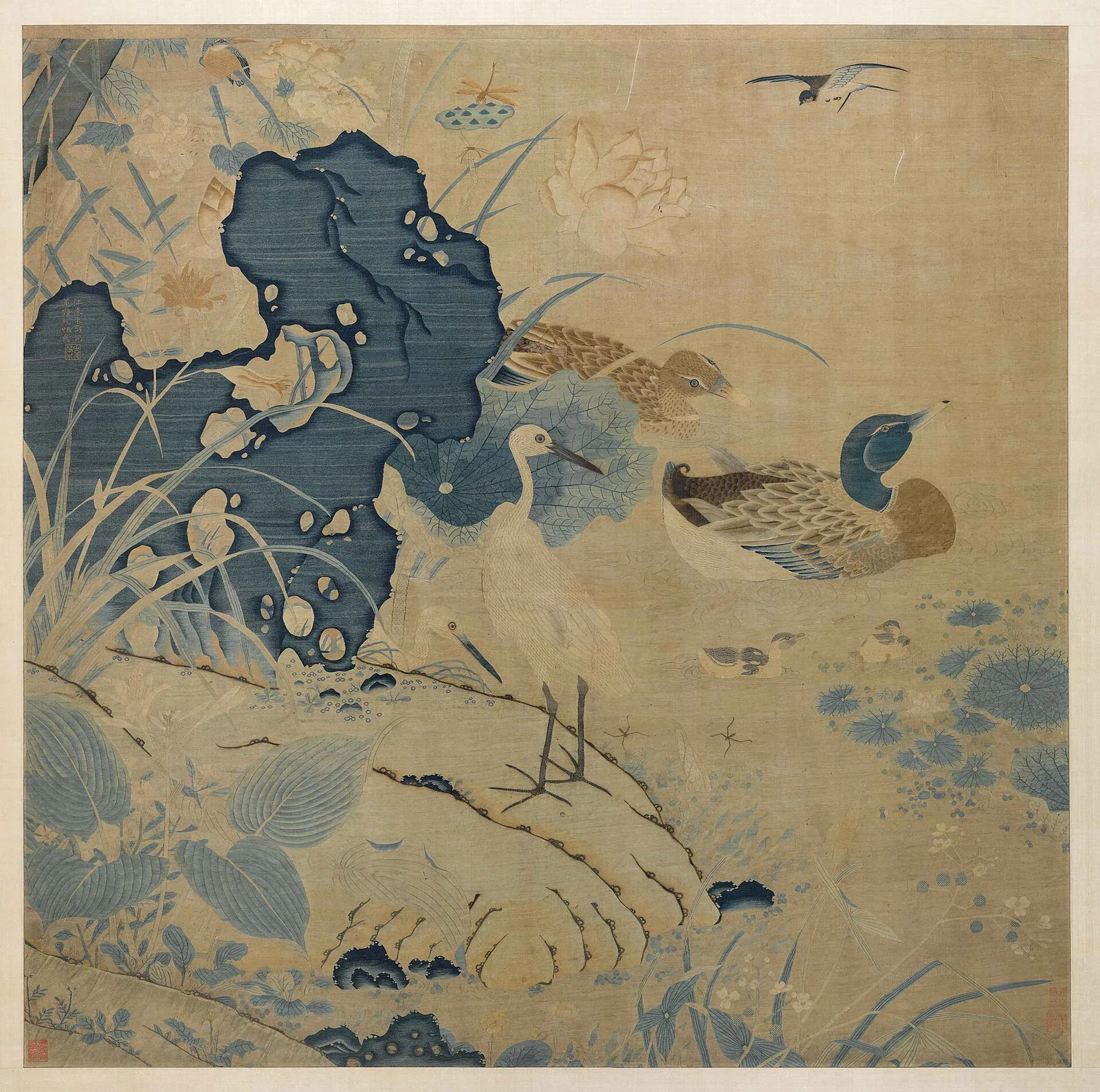
Silk is the material that made Suzhou rich, and the city’s weavers developed two very different ways of making it beautiful. Song brocade is a woven textile: the pattern is created by supplementary threads in the loom. Kesi is a tapestry: the weft is discontinuous, so the weaver can change colour at any point and build an image almost like a painter.
Both are national intangible cultural heritage, and both belong to the wider UNESCO-listed tradition of Chinese sericulture and silk craftsmanship. But they look different, behave differently and are priced by different logic. Knowing which is which will change the way you look at a museum case or a shop.
Two ways to make a pattern
In a brocade, the ground cloth is woven first, and extra weft threads are inserted to create the pattern. The result is a relatively stable fabric with a pattern that is part of its structure. Brocade can be cut, sewn and used for clothing, furnishings, book covers and the mounting of paintings.
In kesi, the weaver uses a plain ground and discontinuous coloured wefts. Each colour is worked only where it is needed, leaving small slits where colours meet. The surface is flat and pictorial, with a slightly stiff hand. The technique is slow, and the result is closer to a tapestry than to a conventional cloth. The Chinese name means “carved silk”, because the colour changes look as if they had been cut into the surface.
| Song brocade | Kesi | |
|---|---|---|
| Structure | Ground weave with supplementary weft | Discontinuous weft, slits between colours |
| Look | Patterned cloth with a soft sheen | Flat, pictorial, slightly stiff |
| Reverse | Relatively clean | Many thread ends and slits |
| Typical use | Robes, furnishings, mounting, covers | Pictorial panels, robes, copies of paintings |
| Price logic | By metre and complexity | By time, fineness and image |
Song brocade
Song brocade originated in the Song dynasty and became one of China’s three famous brocades, alongside Nanjing’s Yun brocade and Sichuan’s Shu brocade. Suzhou’s version is known for its dense, small-scale patterns, its restrained colours and its use in the mounting of paintings and calligraphy. It was a luxury material for robes, furnishings and books.
The craft was added to China’s first national intangible cultural heritage list in 2006. It is still practised in Suzhou, though the market is small and specialised. The best place to see historical examples is the Suzhou Museum West’s Suzhou Crafts Gallery, which displays Song brocade alongside kesi, embroidery and other textile arts.
Kesi
Kesi reached a high point in the Song dynasty. The most famous Suzhou-associated master is Zhu Kerou, whose pictorial tapestries reproduce flowers, birds, rocks and water with extraordinary delicacy. The image at the top of this page is her Lotus Pond and Ducks, a work that shows why kesi was prized by emperors and collectors.
A fine kesi can take months or years. The weaver works from a painting or design, translating brushstrokes into tiny colour changes. The back of the work is a record of the process: hundreds of thread ends, slits and joins. That is one reason kesi is not usually reversible in the way embroidery can be. It is an image built in thread, not a decoration applied to cloth.
Kesi was also used for imperial robes, rank badges and religious textiles. The technique allowed for precise, flat areas of colour and fine detail that ordinary weaving could not achieve. It was expensive because it was slow, and it was slow because it was doing something closer to painting than to cloth-making.
How to tell them apart
At a museum, look at the surface. Brocade has a woven ground and a pattern that sits in the cloth; kesi has a flat, slightly matte surface with tiny slits where colours meet. If you can see the reverse, kesi will have many thread ends; brocade will look more like a normal fabric.
In a shop, ask directly: is this brocade or kesi? A seller who cannot explain the difference is not a reliable guide. Price is another clue. A large hand-woven kesi panel should cost far more than a length of brocade. If the price is low and the story is elaborate, the object is probably neither.
Where to see the best examples
The Suzhou Museum West’s second-floor Suzhou Crafts Gallery is the best single stop. It displays Song brocade, kesi, embroidery, fans, prints and furniture in a purpose-built space. The gallery is free, closed on Mondays, and easy to combine with the rest of the museum.
The Suzhou Silk Museum is the other essential stop. It explains the production process from mulberry leaf to finished cloth, and its collection includes historical textiles. The two museums together give you the technique and the context.
If you are seriously interested in textiles, check the temporary exhibitions at the Suzhou Museum and the China National Silk Museum in Hangzhou. Kesi and Song brocade are fragile, so the best pieces are not always on display. A special exhibition is worth planning a trip around.
Buying and care
New Song brocade is sold by the metre or as accessories: wallets, notebook covers, framed panels, cushions. It is a beautiful material for everyday use, and it is relatively robust. Kesi is a collector’s market. Small pieces can be affordable; large pictorial panels are not. Antique pieces require provenance and expert advice.
Keep both away from direct sunlight, damp and insects. Store textiles flat or rolled with acid-free tissue, not folded on a hard edge. If you are buying a framed piece, ask for UV-filtering glass and a mount that does not press on the textile. A cheap frame can ruin an expensive piece.
Questions people ask
What is the difference between Song brocade and kesi?
Song brocade is a woven silk with a pattern created by supplementary weft threads. Kesi is a silk tapestry with discontinuous wefts, allowing the weaver to build a pictorial image. Brocade is cloth with a pattern; kesi is closer to a painting in thread.
Is kesi embroidery?
No. Kesi is woven, not stitched. Embroidery adds thread to a ground fabric; kesi builds the image into the textile structure itself.
Where can I see Song brocade and kesi in Suzhou?
The Suzhou Museum West’s Suzhou Crafts Gallery and the Suzhou Silk Museum are the best starting points. Temporary exhibitions at the Suzhou Museum may also include textiles.
Why is kesi so expensive?
It is extremely slow to weave, requires great skill, and is often made as a one-off pictorial work. A fine panel can take months. The price reflects labour and expertise, not just materials.