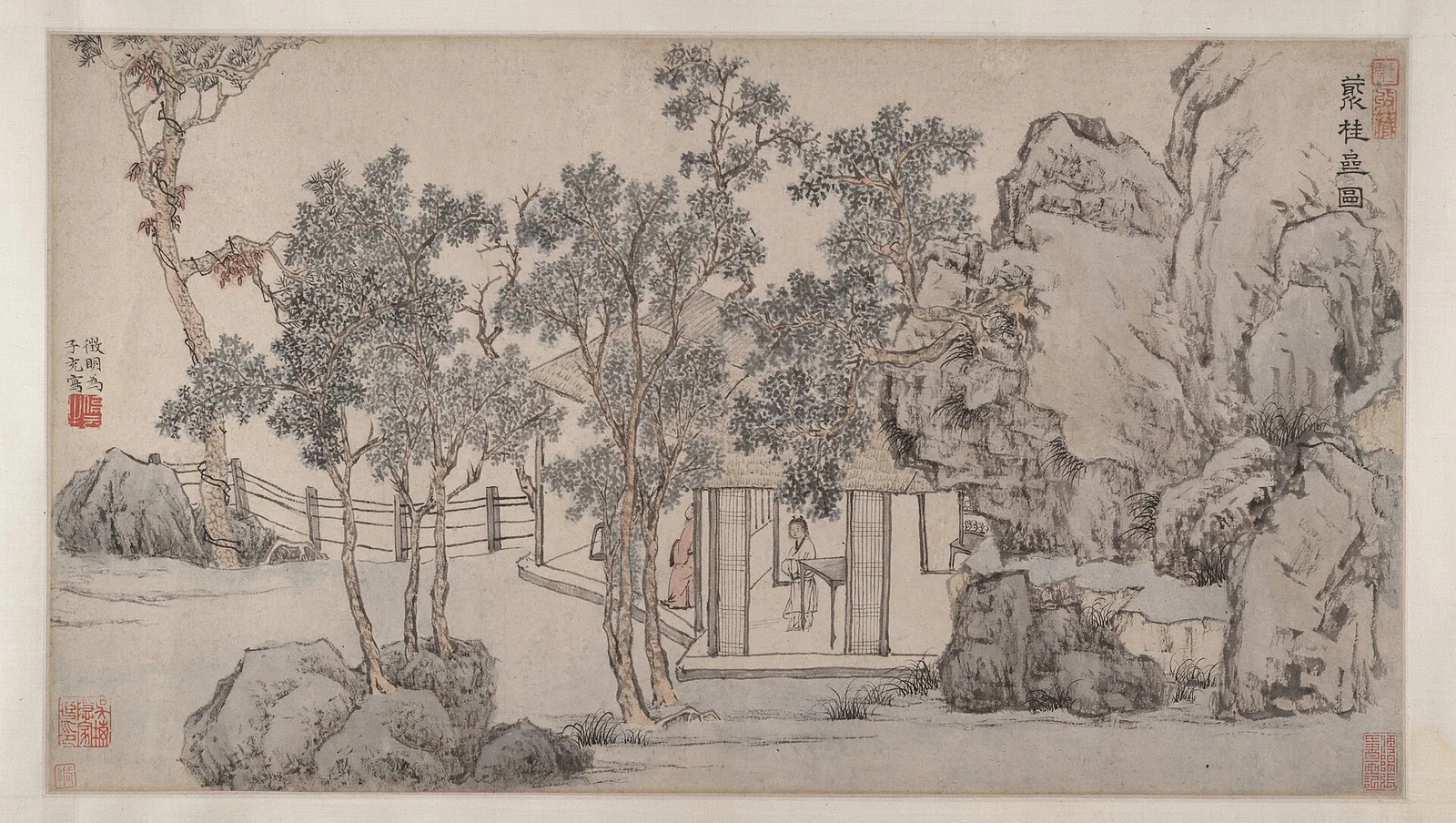
In the Ming dynasty, Suzhou was not only a manufacturing city. It was a cultural capital. Wealthy families collected paintings and books, built gardens and libraries, sponsored painters and musicians, and competed in the examination system. The result was a dense, self-conscious literary culture that shaped everything the city is now famous for.
The best-known product of that culture is the Wu School of painting. The name comes from Wumen, the “gate of Wu”, an old term for the Suzhou region. The school dominated Chinese painting for nearly a century and included the four artists later canonised as the Four Masters of the Ming: Shen Zhou, Wen Zhengming, Tang Yin and Qiu Ying.
The examination city
Suzhou’s scholars were made by the imperial examination system. Boys learned the classics, practised calligraphy and poetry, and sat a sequence of exams that could lead to official rank. The city had academies, libraries and printing houses to support them. Success brought prestige, income and the leisure to paint, garden and collect.
The system also created a large population of educated men who did not become senior officials. Some became teachers, secretaries, publishers, doctors or professional artists. This “surplus” of talent helped make Suzhou a cultural centre: there were enough educated people to sustain poetry societies, publishing projects, opera troupes and art markets.
The Wu School
Shen Zhou (1427–1509) is usually seen as the founder of the Wu School. He came from a wealthy Suzhou family, had a large collection of old paintings, and painted in a deliberately amateur, literati mode: ink landscapes, personal subjects, poems and inscriptions. He was not a court painter, and he did not try to be.
Wen Zhengming (1470–1559) was Shen Zhou’s student and became the leading figure of the next generation. He was a scholar, poet, calligrapher and painter, and he lived long enough to be treated as a living monument. His paintings of Suzhou gardens, including views of the Humble Administrator’s Garden, helped create the image of the city that later travellers came to see.
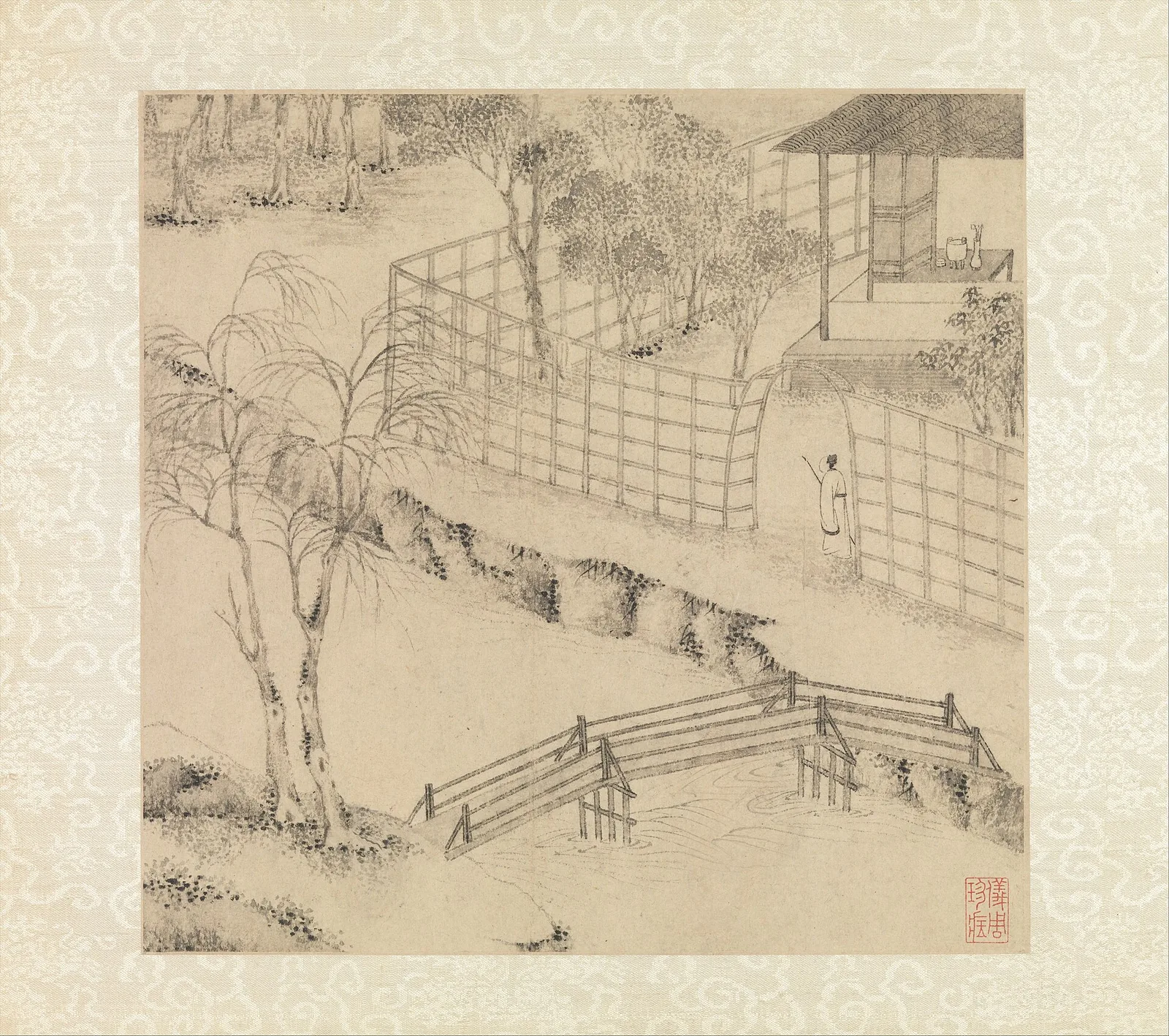
Tang Yin (1470–1524) and Qiu Ying (c. 1494–1552) represent different paths. Tang Yin was a brilliant, erratic scholar-painter whose life became the stuff of legend. Qiu Ying was a professional painter, admired for his fine brushwork and his ability to work in many styles. Together they show that the Wu School was not a single style but a network of careers.
The garden as a study
A Suzhou garden was not primarily a place of display. It was a place to read, write, paint, drink tea, play the qin and receive a small number of guests. The architecture included studios, libraries, pavilions for viewing, corridors for walking in rain, and rooms named after poems. The garden was an extension of the scholar’s study.
The Humble Administrator’s Garden is the classic example. It was created in the sixteenth century by Wang Xianchen, a retired official, and it was painted by Wen Zhengming. The garden’s name comes from a phrase about humble administration, but the garden itself is a statement of taste and wealth. That tension — humility as a literary pose, backed by real money — is very Suzhou.
The Couple’s Retreat is another good example. It was a relatively small garden with a library and a study, built by a scholar who wanted a quiet place to work. Its scale is intimate, and its name refers to a couple growing old together. The garden is not a public park; it is a domestic world made legible through literature.
The printed book
Suzhou was one of the great printing centres of the Ming and Qing. Publishers produced classics, poetry, fiction, illustrated books, medical texts, genealogies and travel guides. The best Suzhou editions were admired for their typography, paper and illustration. Books were not a sideline to the city’s culture; they were its infrastructure.
This is also the context for Taohuawu woodblock prints. The same skills of carving, printing and paper-making that produced fine books also produced cheap, colourful New Year prints for ordinary households. The scholar’s library and the folk print shared a technical world, even if they served different audiences.
Tea, qin and the daily arts
The scholar’s culture was not confined to painting. It included tea, incense, flower arrangement, qin music, chess, calligraphy and the appreciation of stones and antiques. These were not hobbies in the modern sense. They were disciplines that trained taste and judgement, and they were shared across the educated elite.
Biluochun tea, from the hills around Lake Tai, became one of Suzhou’s signature products. The guqin, the quiet seven-string zither, was the scholar’s instrument par excellence. A garden, a cup of tea, a qin and a few friends were the ideal combination. The ideal was often a performance, but it was a performance that produced real art.
Where to see it
The Suzhou Museum is the essential stop. Its collection is strong in Wu School painting and calligraphy, and its building by I. M. Pei is itself a meditation on the scholar’s garden. Look for hanging scrolls, album leaves, fans and calligraphy, and read the inscriptions when they are translated.
The gardens are the other half of the story. Visit the Humble Administrator’s with Wen Zhengming in mind; visit the Couple’s Retreat for the library and the domestic scale; visit the Master of the Nets for the intimate evening version. The gardens are not illustrations of the paintings. The paintings and the gardens are two expressions of the same culture.
For the popular side of the same culture, go to the Taohuawu print museum or the Suzhou Art Museum. For the performing side, see Kunqu or Pingtan. The scholar’s city was not only a world of elite painting; it was a whole ecology of makers, performers and audiences.
How to look at a literati painting
Do not look for perspective or realism. Look at the brushwork: the speed, pressure and texture of the ink. Look at the empty space, which is as important as the painted forms. Read the inscription if you can; it often gives the occasion, the poem and the painter’s mood. Look at the seals, which record ownership and appreciation over centuries.
A literati painting is not a snapshot of a place. It is a record of a mind moving through a landscape, using inherited forms. The pleasure is in the variation: how this painter uses a rock, a tree, a patch of mist. Once you see the conventions, the individuality becomes visible.
Questions people ask
What is the Wu School?
The Wu School was a group of painters centred on Suzhou during the Ming dynasty, from the late fifteenth to the sixteenth century. It emphasised literati values, ink painting, poetry and calligraphy rather than court or professional display.
Who are the Four Masters of the Ming?
Shen Zhou, Wen Zhengming, Tang Yin and Qiu Ying. They are the best-known painters of the Wu School, though their careers and styles differed considerably.
Why did Suzhou scholars build gardens?
A garden provided a retreat for study, painting, tea and conversation, and a way to display taste and status. It was a composed world that combined architecture, water, rock and plants with literary references.
Where can I see Wu School painting?
The Suzhou Museum has a strong collection of Wu School painting and calligraphy. Major museums in Shanghai, Beijing, Taipei and abroad also hold important works.