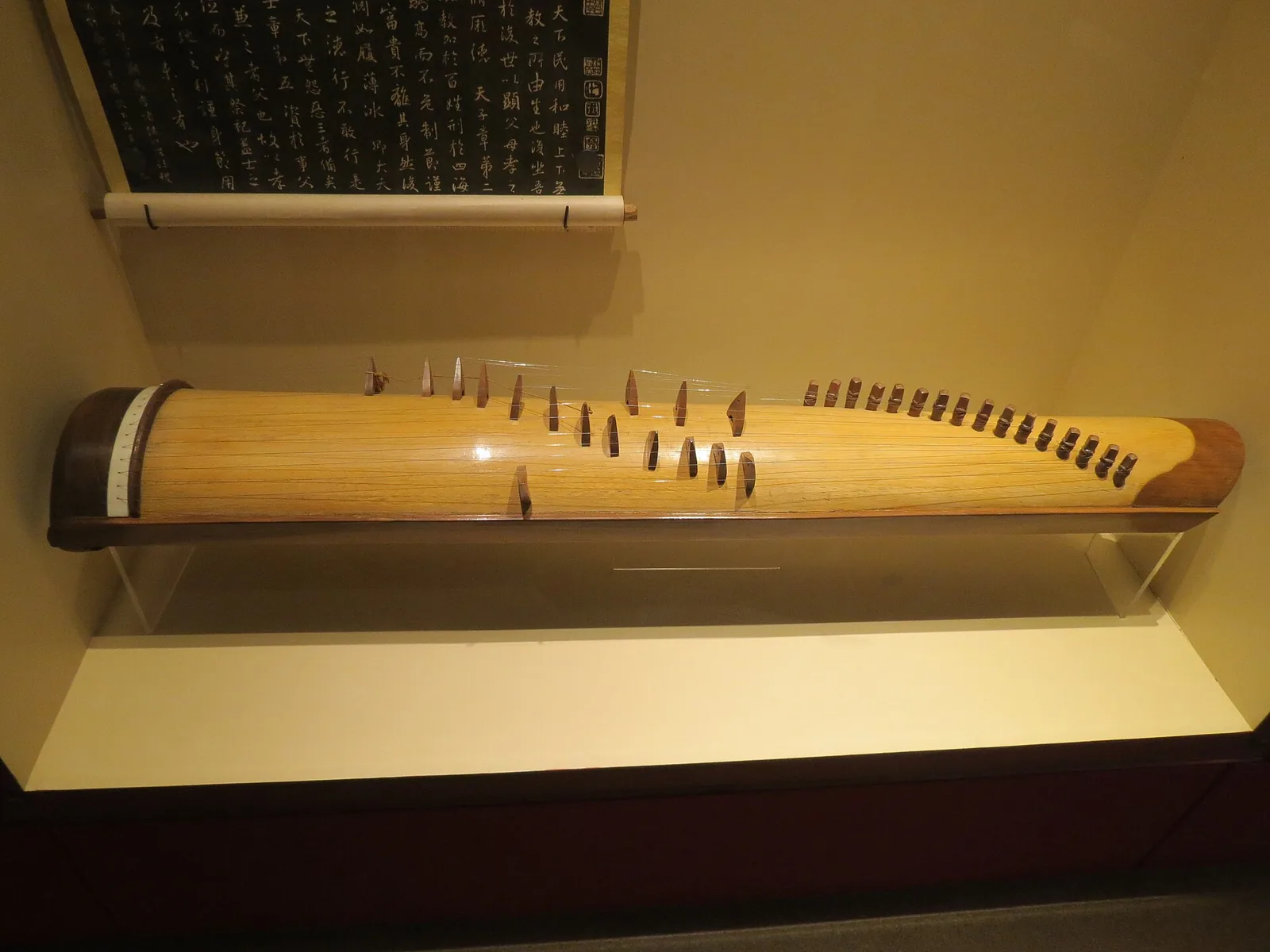
The guqin is a long, narrow wooden zither with seven strings and thirteen studs marking the harmonic nodes. It has no frets and no bridges along the playing length. The strings are plucked with the fingers, and the left hand presses or slides on the strings to change pitch. The sound is soft, with a wide range of overtones and a long decay.
It is often described as the instrument of the Chinese scholar. For centuries it was played in private, for oneself or a small circle of friends, as a discipline of attention rather than a public performance. The UNESCO listing in 2003 recognised not just the instrument but a whole tradition of music, notation, craftsmanship and philosophy.
What the guqin is
The guqin has seven strings, thirteen harmonic markers and a range of about four octaves. It uses three basic techniques: open strings, stopped strings and harmonics. The player can slide, vibrate, pluck, stop and harmonic the same string to produce a wide palette of colours. The instrument is usually made of paulownia or fir, with a lacquered surface and a soundboard that is often curved.
Historically, strings were made of silk, which gives a softer, more complex sound than modern nylon or metal. Many players today use nylon-wrapped silk or synthetic strings for durability. The choice changes the tone, and purists debate it. For a visitor, the important thing is the volume: the guqin is not designed to fill a concert hall. It is designed to be heard in a quiet room.
The scholar’s instrument
In the classic formulation, the educated person was expected to master four arts: qin, chess, calligraphy and painting. The guqin was first among them because it cultivated the self. It was associated with restraint, antiquity and moral seriousness. A scholar might play for a friend, or alone at night, but not for an audience of strangers.
The music is written in a special tablature that records finger positions and techniques rather than pitches. A single piece may exist in many versions, and the player is expected to interpret it, not reproduce it exactly. This makes the tradition both fragile and flexible: it depends on living transmission, but it allows for individual expression.
The Yushan school
The Yushan school was founded in Changshu in the late Ming dynasty by Yan Tianchi. It was one of the first self-conscious guqin schools in China, with a recognised lineage, a repertoire and a style. The school took its name from Yushan, a hill in Changshu, and it became one of the most influential qin traditions in the country.
The Yushan style is often described as broad, peaceful, clear and distant. It values a clean tone, a steady pulse and a sense of space. The school’s early manual, the Songxian Guan Qinpu, helped establish its repertoire. Later teachers such as Xu Qingshan and, in the twentieth century, Wu Jinglüe carried the tradition forward.
Changshu is a county-level city under Suzhou, about 40 minutes by train from the city centre. It is also known as the “hometown of guqin”, with a museum, a qin society and school programmes. For a visitor interested in the instrument, it is worth the half-day.
How to listen
Do not expect a melody in the Western sense. Guqin music is often slow, sparse and modal, with long silences and subtle changes of timbre. Listen to the attack of the note, the decay, the overtones and the spaces between phrases. The instrument rewards close attention, not background listening.
A live performance is much better than a recording. The guqin’s volume is low, and the character of the sound depends on the room, the strings and the player’s touch. Sit near the front if you can. Avoid talking, phone noise and photography with a shutter sound. The silence is part of the music.
Where to hear it
The Changshu Guqin Art Museum is housed in the Ming dynasty Maiwang Guan library on Nanzhao Lane. It displays the history of the Yushan school, the instrument’s construction and the school’s repertoire. It also hosts regular concerts, often monthly; check the schedule before you go. The combination of a Ming library and a quiet guqin recital is one of the best cultural experiences in the Suzhou region.
In Suzhou city, guqin concerts occasionally take place at the Jinji Lake Concert Hall and other venues. The Suzhou Museum and the Kunqu museum may include guqin in special programmes. Teahouses sometimes host small performances, but quality varies; ask who is playing.
If you want to learn, find a teacher before buying an instrument. The guqin is not difficult to start but hard to play well; a good teacher will teach posture, hand position and listening. Serious study takes years. A short workshop can be a pleasant introduction, but it is not a shortcut to the tradition.
Questions people ask
Is the guqin UNESCO-listed?
Yes. The guqin and its music was proclaimed in 2003 and inscribed on UNESCO’s Representative List in 2008.
What is the difference between a guqin and a guzheng?
The guqin has seven strings and a quiet, intimate sound; the guzheng has many more strings (usually 21) and a brighter, louder sound. They are different instruments with different repertoires.
Where can I hear guqin near Suzhou?
The Changshu Guqin Art Museum in Changshu is the best place, with displays and regular concerts. Suzhou city venues occasionally host guqin performances; check listings.
Can a tourist learn the guqin?
Short workshops exist, but the instrument takes years to learn properly. If you are serious, find a teacher and expect to practice daily. Do not buy an expensive instrument before you have had a few lessons.