UNESCO uses two very different instruments. World Heritage protects places: buildings, gardens, canals, archaeological sites. Intangible cultural heritage protects living practices: music, opera, craft techniques, festivals. Suzhou appears on both lists, which is one reason its heritage is so dense — and so easy to misdescribe.
The other complication is that “UNESCO-listed” is often used as a marketing adjective. A craft can be nationally listed, provincially listed, or simply old and admired, without being on a UNESCO list. The distinctions matter if you care about accuracy. They also matter if you are deciding what to see.
The Classical Gardens of Suzhou (1997, extended 2000)
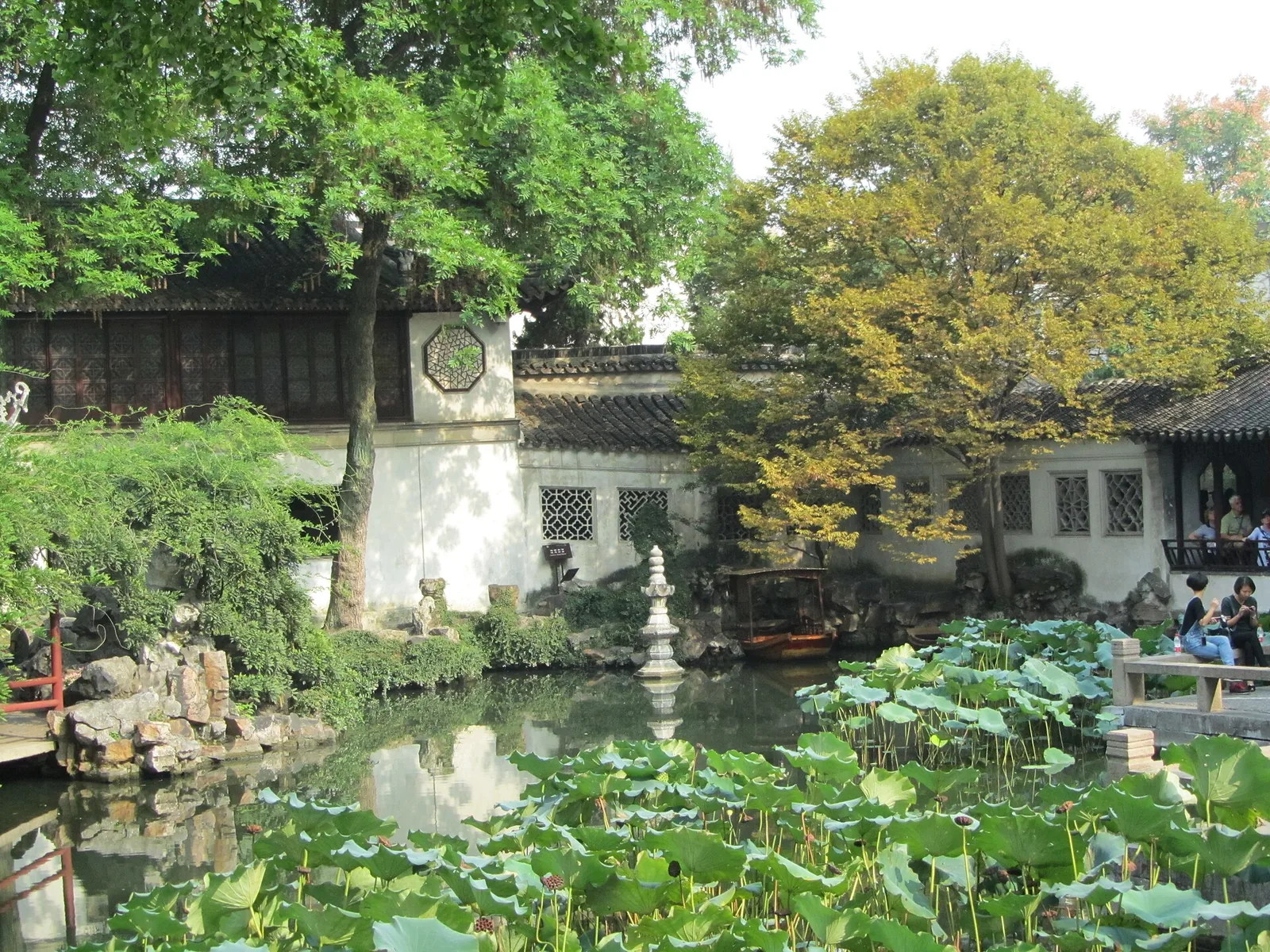
Four gardens were inscribed in 1997: the Humble Administrator’s Garden, the Lingering Garden, the Master of the Nets Garden and the Mountain Villa with Embracing Beauty. Five more were added in 2000: the Lion Grove, Canglang Pavilion, Couple’s Retreat, Garden of Cultivation and the Retreat and Reflection Garden in Tongli. That makes nine gardens in the World Heritage site.
The listing is not a ranking of the nine. It recognises a tradition of garden-making in which water, rock, architecture and planting are composed to create a sequence of views. The gardens are important as a group because they show different solutions to the same design problem: how to make a small walled space feel like a world.
For visitors, the practical consequence is simple. The nine are the core of the classical garden experience, but they are not interchangeable. The Humble Administrator’s is the largest and most public; the Lingering Garden is the most compositionally dense; the Master of the Nets is small and intimate; the Lion Grove is a rockery maze. Choose by temperament, not by UNESCO status.
The Grand Canal (2014)
The Grand Canal is a linear World Heritage site running from Beijing to Hangzhou. Suzhou is one of the most important cities on the route, and several components in and around the city are included: the Pingjiang and Shantang historic districts, Panmen, the Baodai Bridge and the ancient towpath in Wujiang, among others.
The canal is not a monument. It is a working waterway that still shapes the city. The heritage value lies in the relationship between the water, the streets, the bridges, the warehouses and the settlements that grew along it. The best way to see it is not to visit a single “site” but to walk a section and notice how the city turns its back or opens up to the water.
Panmen is the most compact place to see the system: a water gate, a land gate, a bridge and a stretch of wall in one small area. Pingjiang and Shantang show the domestic and commercial sides of canal life. The Baodai Bridge, south of the city, is a beautiful example of canal engineering in a quieter setting.
Kunqu opera (proclaimed 2001, inscribed 2008)
Kunqu is the oldest surviving form of Chinese opera and the most literary. It developed in the Kunshan area near Suzhou in the fourteenth century and matured in the Ming dynasty, when Suzhou’s wealthy literati patronised it. The sixteenth-century musician Wei Liangfu is credited with refining the “water-mill” vocal style that became its signature.
UNESCO proclaimed Kunqu a masterpiece of the oral and intangible heritage of humanity in 2001. It was inscribed on the Representative List in 2008, after the convention’s procedures changed. The distinction between “proclaimed” and “inscribed” is bureaucratic, but it explains why you see both 2001 and 2008 attached to the same tradition.
The practical way to see it is a short excerpt, not a full-length opera. The China Kunqu Opera Museum, housed in the Quanjin Guild Hall on Zhongzhangjia Lane, is the best introduction: the building is a Qing guild hall with a superb stage, the collection explains the form, and the museum hosts performances. The Master of the Nets garden also stages evening excerpts in season.
Guqin and its music (proclaimed 2003, inscribed 2008)
The guqin is a seven-stringed zither, played softly and closely, and for centuries it was the instrument of scholars rather than professional entertainers. It was proclaimed in 2003 and inscribed in 2008. Suzhou’s connection runs through Changshu, where the Yushan school was founded in the late Ming and became one of the most influential qin traditions in China.
The Yushan style is often described as broad, peaceful, clear and distant — a sound that rewards a quiet room and a patient listener. The Changshu Guqin Art Museum, in the Ming dynasty Maiwang Guan library, is the best place to learn about it. Monthly concerts are a rare chance to hear the instrument in an appropriate space.
Xiangshan craftsmanship (2009)
The timber-frame craftsmanship of Chinese traditional architecture was inscribed in 2009. Suzhou’s Xiangshan school of craftsmen is one of its most important living branches. The Xiangshan builders worked on imperial palaces, temples, gardens and ordinary houses, and their techniques — mortise-and-tenon joinery, modular design, carved brackets, tile roofs and rockery — are still used today.
This is the listing that explains the gardens most directly. The garden designer is often remembered; the craftsmen who built the corridors, walls, windows and rockeries are not. The UNESCO listing is a corrective to that. It recognises the building tradition as a living practice, not just a set of old buildings.
Sericulture and silk craftsmanship (2009)
Sericulture and silk craftsmanship was inscribed in 2009, covering mulberry cultivation, silkworm rearing, reeling, thread-making, weaving and finishing in parts of Zhejiang, Jiangsu and Sichuan. Suzhou’s silk industry is part of that wider tradition. Song brocade and kesi, two of the city’s most refined silk arts, belong to the same technical world.
The listing is not a guarantee that every silk product sold in Suzhou is traditional or hand-made. It recognises a set of practices, not a shopping category. If you want to see the real thing, go to the Suzhou Silk Museum or the Suzhou Museum West’s craft gallery, where the process and the history are shown together.
What is not UNESCO
Su embroidery is often described as UNESCO-listed. It is not. It was added to China’s first national list of intangible cultural heritage in 2006. That is a serious designation, but it is not the same as the UNESCO lists. The same is true of Suzhou Pingtan, Taohuawu woodblock prints, Suzhou fans and Ming-style furniture: all are national intangible cultural heritage, not UNESCO elements.
This is not a reason to skip them. National listing is the working level of China’s heritage system, and many of the country’s most important living crafts sit there. The point is simply to use the labels accurately. A craft does not need a UNESCO badge to be worth your time.
| Tradition | Status | Year |
|---|---|---|
| Classical Gardens | World Heritage | 1997, extended 2000 |
| Grand Canal | World Heritage | 2014 |
| Kunqu opera | UNESCO intangible | 2001 / 2008 |
| Guqin music | UNESCO intangible | 2003 / 2008 |
| Xiangshan timber craft | UNESCO intangible | 2009 |
| Sericulture and silk | UNESCO intangible | 2009 |
| Su embroidery | National ICH | 2006 |
| Pingtan | National ICH | 2006 |
| Taohuawu prints | National ICH | 2006 |
| Suzhou fans | National ICH | 2006 |
| Ming-style furniture | National ICH | 2006 |
How to visit the UNESCO city
The efficient route is a garden at opening, the Suzhou Museum, a canal walk and one performance. That gives you one World Heritage site, the best museum introduction, the canal and an intangible tradition in two days. Add the Silk Museum or Suzhou Museum West for the craft layer, and Panmen for the canal’s engineering.
Do not try to “collect” the listings. The gardens alone could take a week. The point is to understand the system that produced them: water, money, scholarship, craft and a particular way of looking at the world. The labels are an index, not the book.
Questions people ask
Is Su embroidery UNESCO-listed?
No. Su embroidery is on China’s national intangible cultural heritage list (2006). It is not on a UNESCO list. Kunqu opera, guqin, Xiangshan timber craftsmanship and sericulture are the UNESCO-listed traditions represented in Suzhou.
How many UNESCO gardens are in Suzhou?
Nine classical gardens are part of the World Heritage site: four inscribed in 1997 and five added in 2000.
Is the Grand Canal in Suzhou?
Yes. Suzhou is one of the most important cities on the Grand Canal, and several canal-related sites in and around the city are part of the 2014 World Heritage inscription.
Is Suzhou a UNESCO city?
Suzhou has World Heritage sites and UNESCO intangible heritage, and in 2014 it joined the UNESCO Creative Cities Network as a City of Crafts and Folk Art. That is a different programme from World Heritage.