Xiangshan is a hill and a cluster of villages in Wuzhong, west of Suzhou, near Lake Tai. For centuries it produced carpenters, masons, stone-cutters, brick carvers, lacquerers and rockery builders who worked across the Yangtze delta. The local saying is blunt: all the fine carpenters of Jiangnan come from Xiangshan.
The Xiangshan school — Xiangshan Gang in Chinese — is not a single workshop or a family firm. It is a regional tradition of training and practice, passed from master to apprentice, with a shared toolkit of techniques and a shared aesthetic. Its most famous member was Kuai Xiang, the Ming carpenter credited with building the Forbidden City.
A village guild that built a capital
Kuai Xiang was born in Xiangshan in 1398. He was summoned to Beijing during the Yongle emperor’s construction of the new capital and rose to a senior position in the imperial works. He is associated with the main halls of the Forbidden City, the Tiananmen gate and the Ming imperial tombs. The emperors are said to have called him “Kuai Luban”, after the legendary carpenter of Chinese antiquity.
The details of attribution are debated by architectural historians, as they are for most large pre-modern building projects. What is not debated is the influence. The Xiangshan tradition supplied the technical vocabulary for imperial architecture and for the gardens and temples of the south. It travelled with the craftsmen.
Eight trades, one building
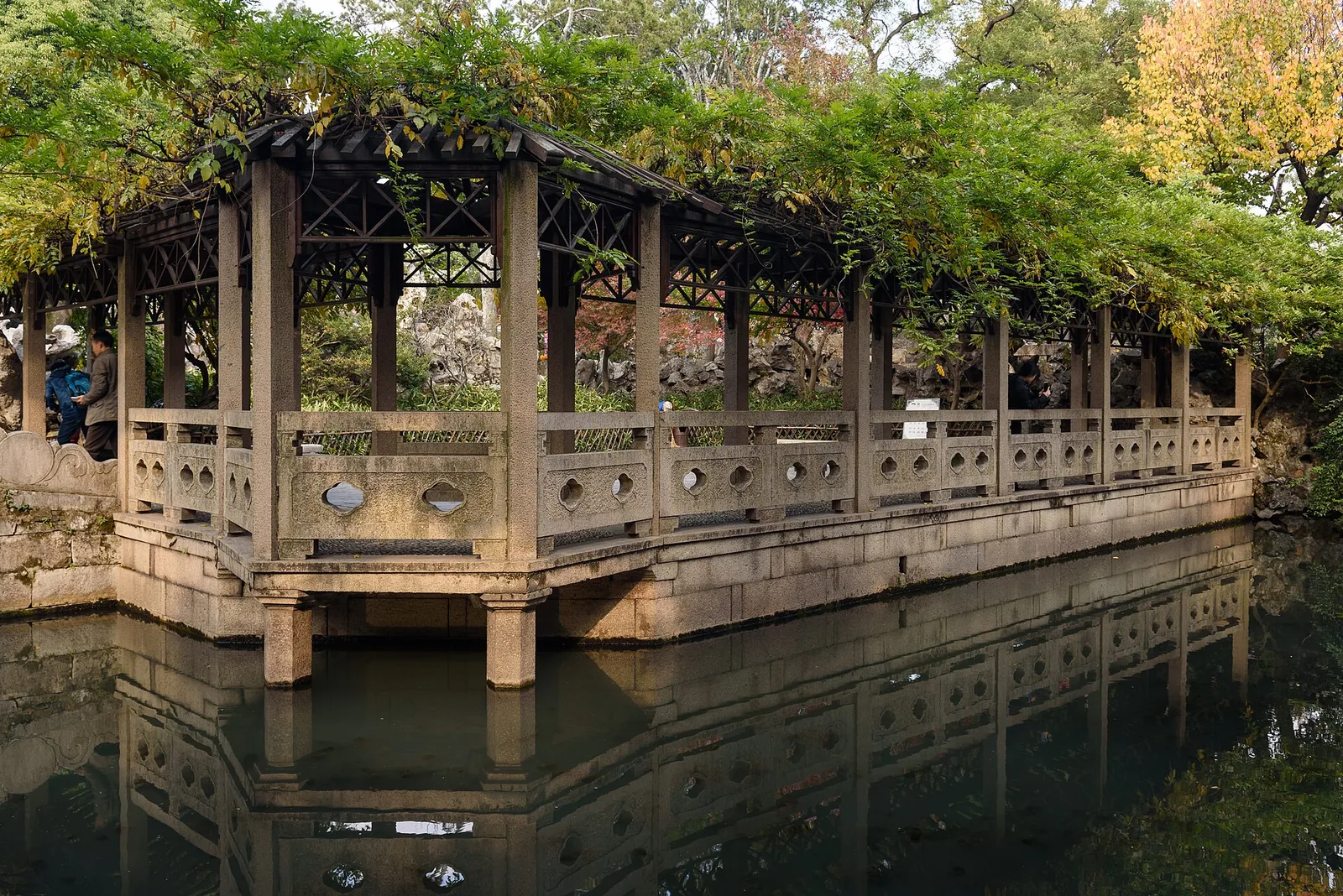
The tradition is usually described as eight trades: woodwork, masonry, stonework, brick carving, wood carving, lacquer, painting and rockery. In practice they were combined on a single site. A garden pavilion needed a carpenter for the frame, a mason for the walls, a stone-cutter for the steps, a carver for the brackets, a painter for the finish and a rockery specialist for the mountain.
The structural principle is mortise-and-tenon joinery. Wooden columns, beams, purlins and brackets are cut to fit together without nails, with a flexibility that helps a building survive movement and earthquakes. The system is modular: components can be prefabricated, transported and assembled on site. That is one reason Xiangshan craftsmen could work far from home.
The aesthetic is equally important. Xiangshan buildings are not restrained because the craftsmen lacked skill. They are restrained because the joinery, the proportion and the material are allowed to do the work. Ornament is concentrated where it matters: a carved bracket, a lattice window, a door panel, a ridge.
The gardens as craft
The classical gardens are usually interpreted as literary landscapes: a rock that evokes a mountain, a window that frames a poem, a pavilion named after a line of verse. All true. But the literary idea had to be built, and the builders were Xiangshan craftsmen. The garden is a collaboration between a scholar’s programme and a craftsman’s knowledge.
Look at the details. The covered corridor at Lion Grove, the lattice windows at the Couple’s Retreat, the paving patterns at the Lingering Garden, the roof brackets at the Humble Administrator’s: these are not generic “Chinese” features. They are the product of a specific regional building culture with its own rules for proportion, jointing and finish.
The rockeries are the clearest example. A Taihu limestone rockery is not a pile of stones. It is a composition, built from the inside out, with hidden supports, planned sightlines and a path that controls how the visitor sees it. The rockery masters were among the most respected of the Xiangshan trades.
The UNESCO listing
Xiangshan traditional building craftsmanship was added to China’s first national intangible cultural heritage list in 2006. In 2009 it was included in UNESCO’s Representative List as part of “Chinese traditional architectural craftsmanship for timber-framed structures”. The UNESCO element is broader than Xiangshan, but the Suzhou school is one of its most important branches.
The listing recognises a living practice, not just old buildings. It covers the knowledge of joinery, materials, proportions, decoration and site work that is transmitted through apprenticeship. It also draws attention to the threat: fewer young people are willing to spend years learning a trade that is physically demanding and poorly paid at the start.
Where to see the work
The best place is a classical garden, looked at slowly. The Humble Administrator’s, Lingering Garden, Lion Grove and Master of the Nets all contain Xiangshan work. Do not just photograph the pond. Look up at the roof, down at the paving, and through the windows. The craft is in the transitions.
The Suzhou Museum West’s Suzhou Crafts Gallery provides the context: models, tools, materials and objects that explain how the building tradition fits with the city’s other crafts. The Suzhou Museum’s main building, designed by I. M. Pei, is a modern meditation on the same vocabulary of white walls, grey roofs and framed views.
The tradition also travelled. Xiangshan craftsmen built the Astor Court at the Metropolitan Museum in New York (1980), the Dr. Sun Yat-sen Classical Chinese Garden in Vancouver (1986) and Lan Su Chinese Garden in Portland (2000). These are not replicas of Suzhou gardens; they are exercises in the same craft, built by the same lineages.
The craft today
Xiangshan workshops still build and restore gardens, temples and traditional houses. Some work on heritage projects; others build new “classical” buildings for hotels, parks and cultural centres. The best work is distinguished by the same things as always: correct joinery, honest materials, good proportion and a lack of decorative noise.
If you are commissioning work or buying a traditional building, ask who is doing the joinery and where the craftsmen trained. The name “Xiangshan” is used loosely. The tradition is real, but not every contractor who claims it is a bearer of it.
Questions people ask
Who was Kuai Xiang?
Kuai Xiang (1398–1481) was a Ming dynasty master carpenter from Xiangshan, near Suzhou. He is credited with a leading role in the construction of the Forbidden City and is regarded as the patriarch of the Xiangshan school.
Did Xiangshan craftsmen build Suzhou’s gardens?
Yes. The classical gardens were designed by scholars and built by craftsmen, many of them from the Xiangshan tradition. Their work is visible in the timber frames, roof brackets, lattice windows, paving and rockeries.
Is Xiangshan craftsmanship UNESCO-listed?
Yes. It was included in UNESCO’s Representative List in 2009 as part of “Chinese traditional architectural craftsmanship for timber-framed structures”. It is also on China’s national list (2006).
Where can I see Xiangshan work outside Suzhou?
The Astor Court at the Metropolitan Museum in New York, the Dr. Sun Yat-sen Classical Chinese Garden in Vancouver and Lan Su Chinese Garden in Portland were all built by Suzhou craftsmen in the Xiangshan tradition.