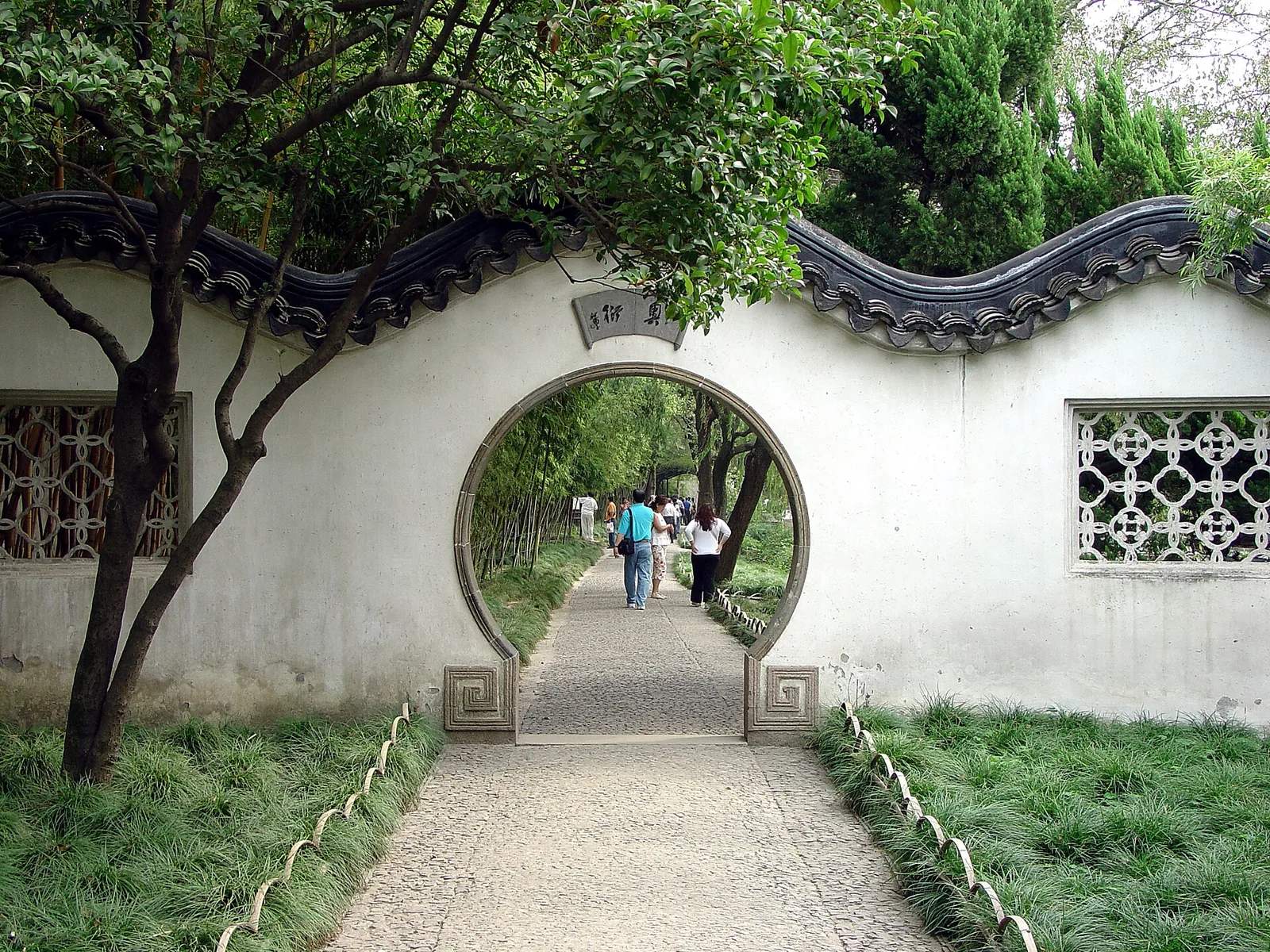
The first time you enter a Suzhou garden, you may be underwhelmed. The pond is small. The pavilion is shabby. The rockery looks like a pile of grey stones. Then you walk ten metres, turn a corner, and the same elements arrange themselves into a perfect picture. That is not an accident. The garden was designed to do exactly that.
Classical gardens were built by scholars and officials who could not travel freely or build grandly. Within a walled plot, they made a world: a mountain from a rock, a river from a pond, a forest from a few trees. The technique is not realism. It is suggestion. The garden gives you enough to complete the picture yourself.
1. The frame
A doorway, a window, a gap in a wall. The garden constantly frames what you are about to see, so that the view arrives as a composed image rather than a panorama. A moon gate is the most famous version: a circular opening that turns the garden beyond into a hanging scroll. Lattice windows do the same thing in miniature, each pattern producing a different crop of leaves and water.
When you walk through a garden, stop at every doorway before you pass through it. Look at what the architect has put in the frame. That is the intended first impression.
2. The borrowed view
The garden borrows scenery from outside its walls: a distant pagoda, a roofline, a tree, the sky. The North Temple Pagoda is visible from parts of the Humble Administrator’s Garden, and the design leans on it. The wall does not shut the world out; it selects the best parts of it.
This is why the gardens feel larger than their area. They are not self-contained. They are in conversation with the city around them, even when the city is invisible.
3. The corridor
Covered corridors do more than keep the rain off. They control pace, direction and attention. A corridor narrows your field of view, then opens it at a pavilion. It turns a short distance into a sequence. It makes you walk slower. In the Lingering Garden, the corridors are the main event: they weave along walls, over water, and through courtyards, giving you a new view at every turn.
The path is the argument. The destination is only the proof.
A note from the editor
4. Water and rock
Water is the centre of most gardens because it doubles the sky, the pavilions and the trees. A small pond becomes a large world. The irregular edges matter: a straight concrete bank would kill the illusion, so the water is edged with stone, plants and recesses that make it look like a natural shore.
Rock is the mountain. Taihu limestone, eroded into holes and peaks, was sunk in lakes and retrieved by divers, then arranged into artificial mountains. The best rockeries are not meant to be climbed so much as read: a cliff, a cave, a ridge, a path that disappears. Lion Grove takes this to its logical extreme and turns the mountain into a maze.
5. The false path
Suzhou gardens rarely show you the direct route. A path will lead to a wall, turn, and reveal a door. A bridge will cross the pond at an angle. A corridor will end in a window rather than an exit. This is deliberate. The detour creates suspense, and suspense makes the view feel earned.
If you find yourself walking in a straight line for more than a minute, you have probably left the garden’s logic. Turn back and take the other path.
6. The name
Every pavilion, hall and rockery has a name, usually a line of poetry or a private joke. The names are not decoration. They tell you what the owner wanted you to notice: the sound of rain, the smell of lotus, the view at dusk. “Listening to the Rain Pavilion” is an instruction. “The Hall of Thirty-Six Pairs of Mandarin Ducks” is a wish for domestic happiness.
You do not need to read every plaque. Pick three or four and let them change how you look at the space. A garden with names is a garden with a script. You are allowed to improvise.
Questions people ask
Do I need a guide to understand the gardens?
No. A short primer like this one is enough to start. A good guide can add history and names, but the visual grammar is best learned by standing still and looking.
Which garden best shows these principles?
The Lingering Garden for corridors and rockery, the Humble Administrator’s for water and borrowed views, and the Master of the Nets for intimate framing. Visit one, then another, and the grammar becomes obvious.
Are the gardens better in spring or autumn?
Both are excellent. Spring has blossom and fresh green; autumn has yellow leaves, osmanthus and clearer light. Summer is lush but crowded and hot; winter is quiet and structurally revealing.