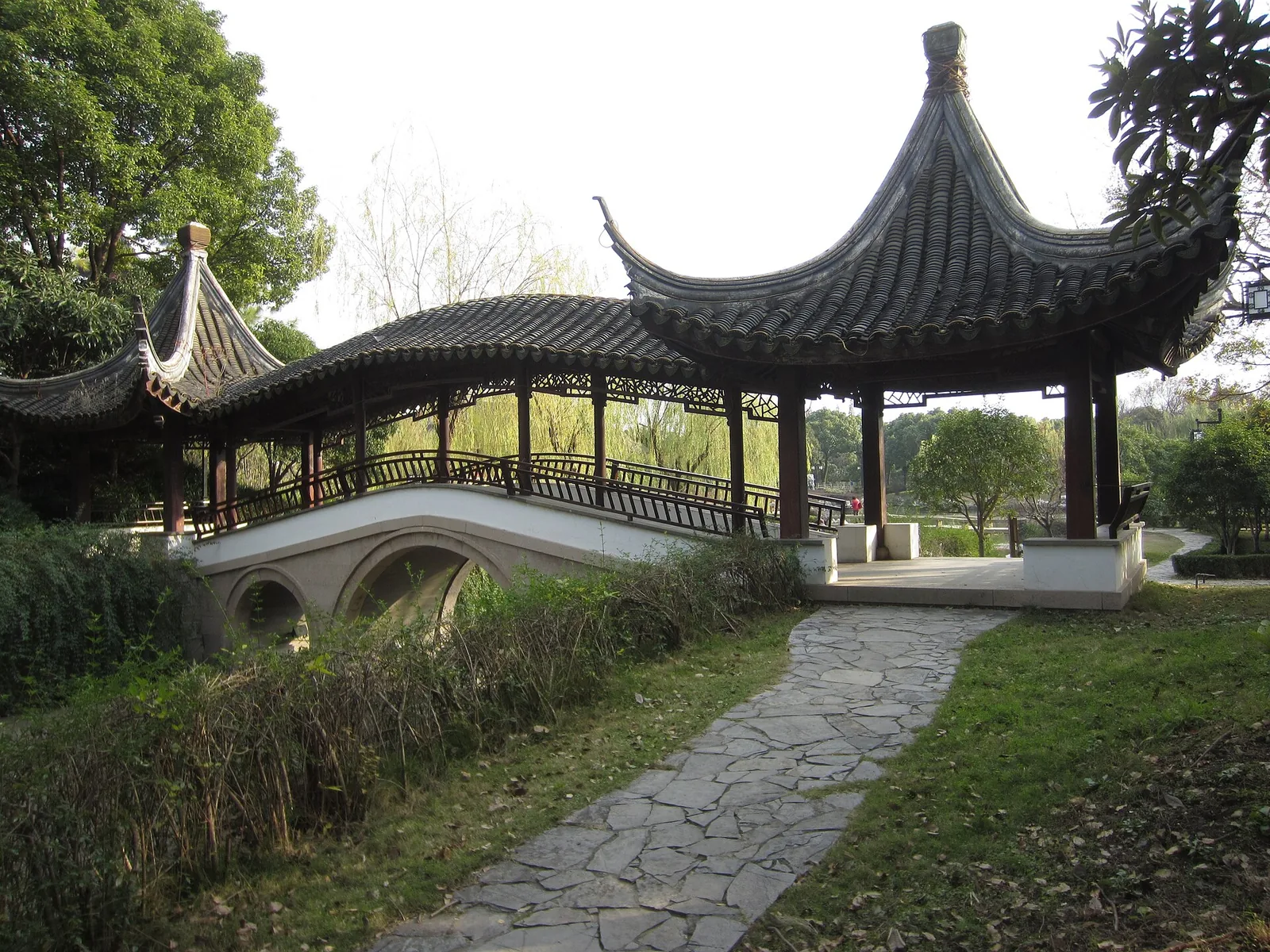
The traditional date for the founding of Suzhou is 514 BC. King Helü of Wu moved his capital to the site and had its walls and gates laid out by his minister Wu Zixu. The city was called Gusu, and the basic relationship between the old town, the canals and the surrounding water landscape has been recognisable ever since.
That does not mean the city is a frozen relic. Suzhou has been destroyed, rebuilt, occupied and re-invented many times. What survives is not a single ancient fabric but a pattern: a walled centre, a grid of canals, a hinterland of lakes and rice fields, and a habit of making things with unusual care.
A Wu capital
The state of Wu was one of the powers of the Spring and Autumn period, and its capital was a political and military project. The walls had eight gates, the canals connected the city to the wider water network, and the surrounding landscape was managed for defence, transport and agriculture. Little of the Wu palace survives above ground, but the shape of the old town still remembers it.
The Wu connection is more than a founding myth. It gives Suzhou a claim to a distinct regional identity: a southern capital with its own speech, food, music and craft traditions. When people say Suzhou feels different from northern Chinese cities, they are partly responding to that older political geography.
The Grand Canal changes everything
The decisive change came in the Sui dynasty, when the Grand Canal was extended and connected to the Yangtze and the rice fields of the south. Suzhou sat on the Jiangnan Canal, the section that carried grain, silk, salt, timber and people between the Yangtze and Hangzhou. The city became a warehouse, a market and a administrative centre at the same time.
The canal made Suzhou rich, and wealth made the gardens possible. It also made the city cosmopolitan in a quiet way: merchants, officials, monks, craftsmen and scholars passed through, bringing ideas and money. The old saying that above there is heaven and below there are Suzhou and Hangzhou is a later expression of that prosperity, but the conditions for it were laid by the canal.
The name Suzhou dates from 589, when the Sui renamed the commandery. It comes from a nearby hill, not from the word for “awakening” that appears in some romantic explanations. The city has been called many things since, but the name has stuck.
The Ming and Qing boom
By the Ming and Qing dynasties, Suzhou was one of the wealthiest and most cultured cities in China. Silk production, dyeing and finishing employed thousands. The examination system produced a dense network of scholars and officials. Printing, painting, opera and garden-building all flourished on the same pool of money and literacy.
This is the Suzhou most visitors imagine: the classical gardens, the canals lined with whitewashed houses, the opera, the embroidery, the delicate food. It was also a city of sharp inequality. The gardens were built by officials and merchants, on land and labour that were not equally distributed. The beauty was real; so was the cost.
The Taiping Rebellion shattered the city in the 1860s. Suzhou was occupied, fought over and badly damaged; many of its buildings and collections were lost. The city recovered, but the balance of power in the region was shifting to Shanghai, which had been opened to foreign trade in 1842.
Treaty port and modern city
The Treaty of Shimonoseki in 1895 opened Suzhou to foreign trade, and a Japanese concession was established in the south of the city. The results were limited. Shanghai was already the region’s international port, and Suzhou’s advantage in silk and scholarship did not translate easily into industrial power.
The twentieth century brought war, occupation and revolution. In the reform era, Suzhou’s old town was protected more than many Chinese cities, while new development was pushed outward. The China-Singapore Suzhou Industrial Park, begun in 1994, created a modern economy to the east. The old town and the new city became two different Suzhous, visible from the same map.
The classical gardens were inscribed on the UNESCO World Heritage list in 1997, with an extension in 2000. The Grand Canal was inscribed in 2014. In 2014 Suzhou also joined the UNESCO Creative Cities Network as a City of Crafts and Folk Art. These labels did not create the heritage, but they changed how the city presents it.
What survives, and where to see it
The city walls are mostly gone. Panmen is the best surviving water gate and a good place to understand how the wall, the canal and the moat worked together. The Grand Canal still carries boats; the section around Panmen and the restored stretches at Pingjiang and Shantang show the old relationship between water and street.
The Suzhou Museum is the best single introduction to the city’s history and material culture. The gardens show the taste of the elite; the Silk Museum shows the industry that paid for it; the embroidery and craft collections show the labour behind the refinement. The old town’s street pattern is the largest exhibit of all, and it is free.
| Layer | Where to see it | What it tells you |
|---|---|---|
| Wu capital | Panmen, the old town street pattern | The city began as a fortified southern capital |
| Canal city | Grand Canal, Pingjiang, Shantang | Water was infrastructure, not scenery |
| Ming-Qing city | Gardens, Suzhou Museum, Silk Museum | Wealth, scholarship and craft fed each other |
| Treaty port | The old concession area south of the centre | Suzhou’s global century was partial and uneven |
| Modern city | Suzhou Industrial Park, Jinji Lake | The old town was preserved by building elsewhere |
How to use the history
If you have one day, pair Panmen with the Suzhou Museum. If you have two, add a garden at opening and a canal walk at dusk. If you have three, add the Silk Museum or the Suzhou Museum West and a performance. The history is not separate from the sights; it is the reason they look the way they do.
The most useful question to carry around is not “How old is this?” but “What paid for it?” The answer is usually water, silk, grain, scholarship or a combination of all four. Once you start asking that, the city becomes legible.
Questions people ask
How old is Suzhou?
The traditional founding date is 514 BC, when King Helü of Wu established his capital at the site. The city has been continuously important since then, though its buildings have been rebuilt many times.
Was Suzhou always called Suzhou?
No. It was historically called Gusu and Wuzhou, among other names. The name Suzhou dates from 589, during the Sui dynasty.
What happened to the Suzhou city walls?
Most of the walls were demolished in the twentieth century. Panmen, a surviving water gate and wall section in the south-west of the old town, is the best place to see what they were like.
Is Suzhou older than Shanghai?
Yes. Suzhou was a major city centuries before Shanghai became important. Shanghai overtook Suzhou economically in the nineteenth century, especially after it became a treaty port in 1842.