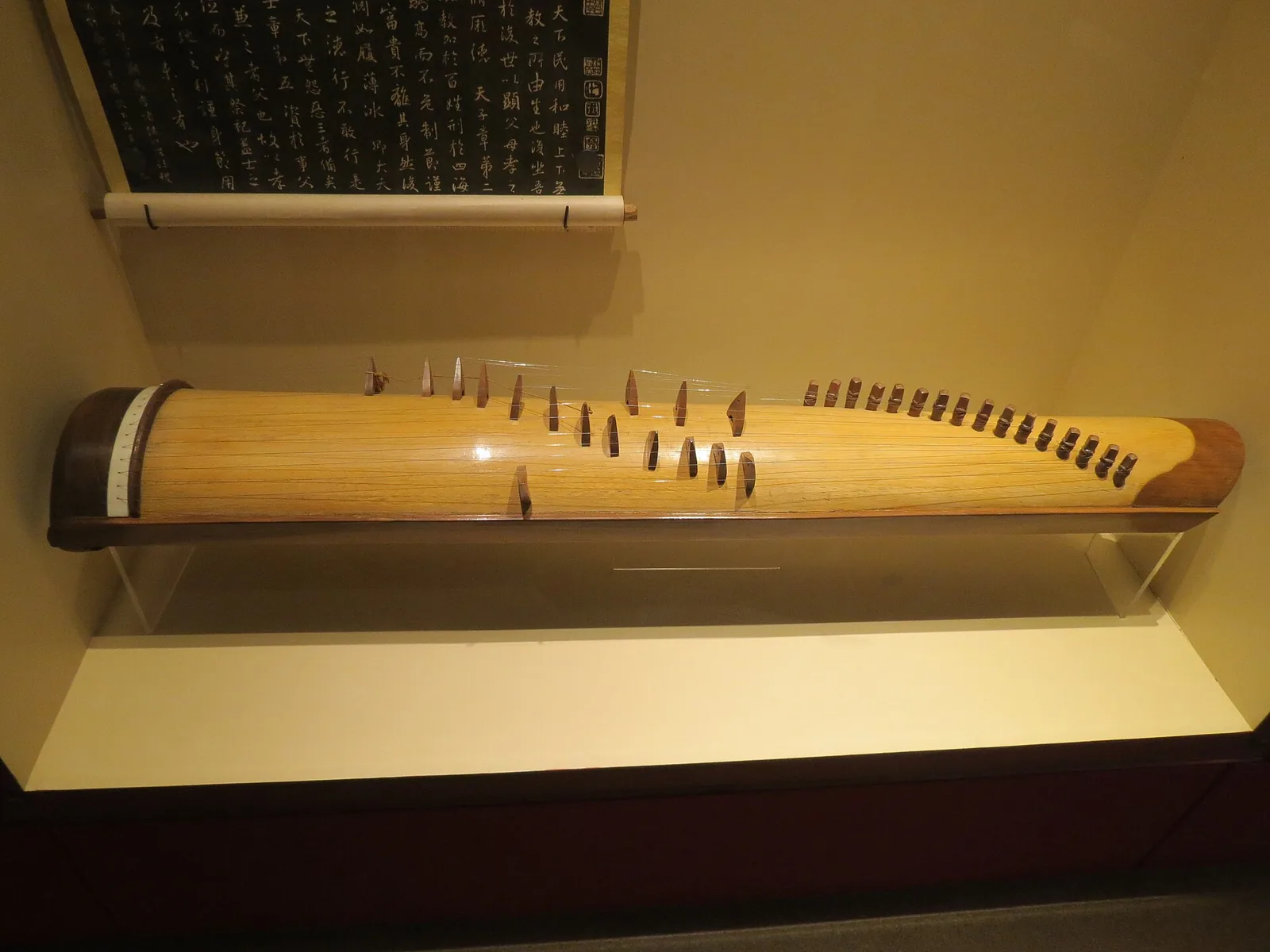
The guqin has seven strings, no frets and a volume closer to a whisper than a performance. It was the instrument of the Chinese scholar, played for oneself or a few friends. Hearing it live, in a quiet room, is a different experience from hearing a recording.
The instrument has thirteen studs marking the harmonic nodes. The strings are plucked with the fingers, and the left hand presses or slides on the strings to change pitch. The sound is soft, with a wide range of overtones and a long decay. It is designed to be heard in a small room, not projected to the back of a hall.
What actually happens
We meet in a quiet room — a teahouse, a studio or a small hall, depending on the musician and the day. The player begins with a short explanation of the instrument: the strings, the studs, the three basic techniques, and the difference between silk and modern strings. Then they play.
You will hear one or two pieces, with time to listen to the decay of the notes and the spaces between phrases. The player will explain the structure of the music and the notation, which records finger positions rather than pitches. There is no obligation to follow the theory; the point is to listen better.
If you want, you can try the instrument. A beginner’s lesson covers posture, hand position and a simple phrase. It is harder than it looks, and that is useful. The session ends with tea and questions.
Suzhou or Changshu
Suzhou city has guqin players and occasional concerts, but the deepest context is in Changshu, about 40 minutes by train. The Changshu Guqin Art Museum is housed in a Ming library and hosts regular concerts. If your schedule allows, the Changshu version is worth the half-day. If not, the Suzhou city version is a good introduction.
Changshu is also the home of the Yushan school, founded in the late Ming dynasty by Yan Tianchi. The school’s style is often described as broad, peaceful, clear and distant. It values a clean tone, a steady pulse and a sense of space. Hearing a player from that lineage in a Ming library is one of the best cultural experiences in the region.
Who it is for
It suits travellers who value quiet, music, or the scholar’s tradition. It suits anyone who wants a counterweight to the crowds. It does not suit anyone who expects a concert-hall performance, a costume show, or a packaged “ancient culture” experience.
What is included
- A private session with a guqin player.
- A short introduction to the instrument and its tradition.
- Live music, and a beginner’s lesson if you want one.
- Tea and English interpretation.
Not included: transport to Changshu, meals, and any instrument you choose to buy. I do not recommend buying an instrument before you have studied for a while.
A note on price
The session is quoted per group. The musician’s time and the room are the main costs. I confirm the quote and the location before you commit.
How to arrange it
Tell me your dates, group size and whether you want Suzhou or Changshu. I will check the player’s availability and reply with a shape and a quote. Two weeks’ notice is usual.
Questions people ask
Do I need musical training?
No. The session is designed for curious listeners, not musicians. A little patience helps.
Can I learn to play?
You can try a beginner’s phrase. Serious study takes years; a short lesson is an introduction, not a shortcut.
Is the guqin the same as the guzheng?
No. The guqin has seven strings and a quiet, intimate sound. The guzheng has many more strings and a brighter, louder sound.
Is Changshu worth the trip?
Yes, if you care about the tradition. The museum is in a Ming library and the concerts are excellent. It is about 40 minutes by train from Suzhou.