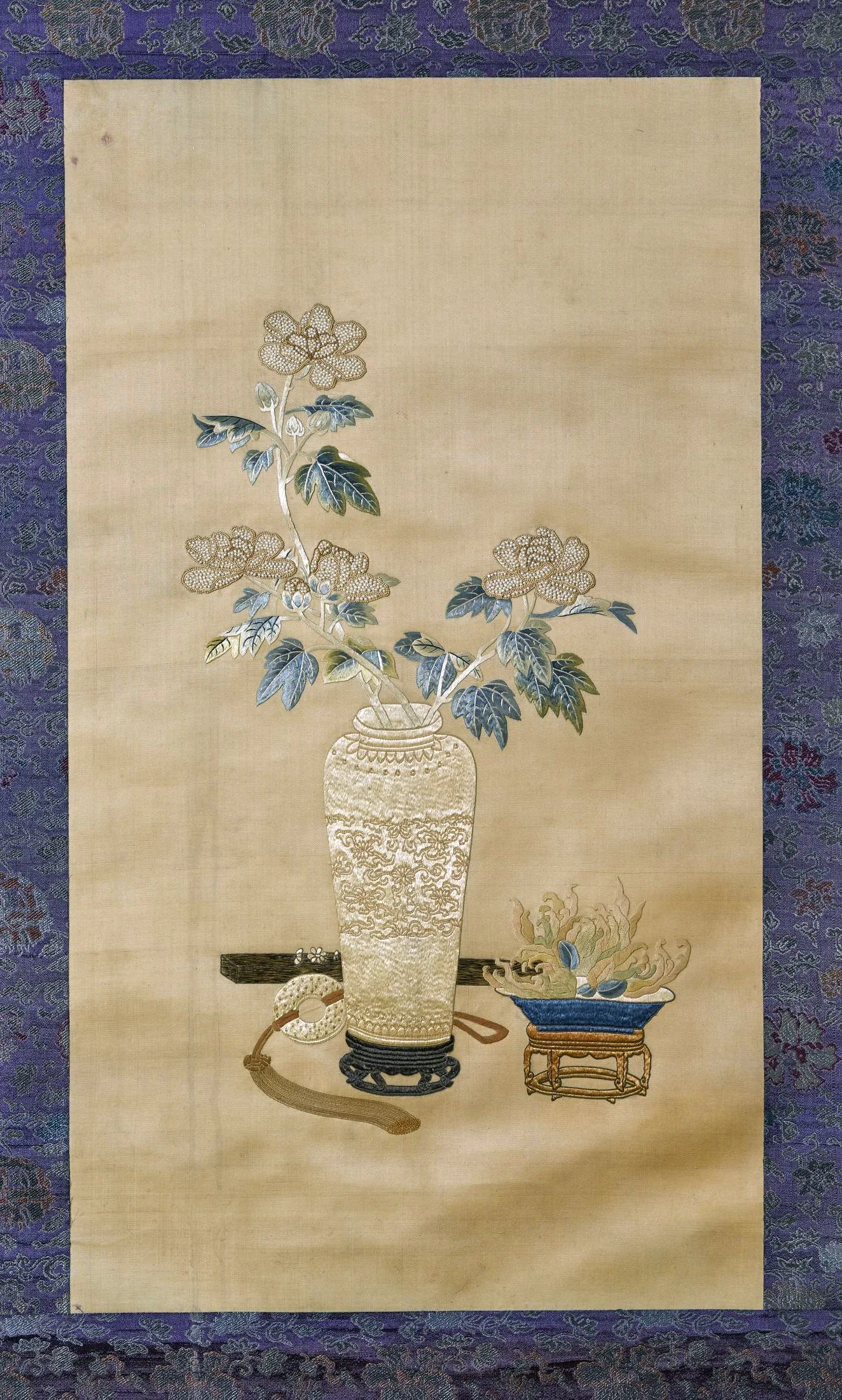
Su embroidery — Su xiu — is the embroidery tradition of Suzhou and the wider Jiangnan region. It is counted among China’s four great embroideries, alongside the traditions of Hunan, Guangdong and Sichuan, and it is the one most often described as refined. The label is not just civic pride. It describes a set of techniques, a colour sense and a standard of finish that are recognisably different from the other schools.
The craft is usually dated back more than two thousand years, with early examples found in the region and a clear flowering in the Song dynasty. It began as practical and religious work — clothing, temple banners, accessories — and gradually became pictorial. By the Ming and Qing dynasties, Suzhou’s embroiderers were making hangings, robes, screens and framed panels for officials, merchants and the imperial court. The city’s Imperial Silk Manufactory was not a decorative detail: Suzhou was a production centre for the clothes of power.
Why Suzhou
Three things made the craft here. The first was silk: the Yangtze delta produced the fibre, and Suzhou’s workshops could reel, dye and weave it to an unusual standard. The second was money. A wealthy, literate elite wanted beautiful objects for daily use, and it paid for the time those objects required. The third was taste. Suzhou’s painters, poets and garden-makers gave embroiderers a visual language: birds, flowers, rocks, water, calligraphy, and the careful empty space of a literati painting.
Embroidery was also women’s work, and that matters to the story. For centuries, a girl’s training in needlework was part of her education; a fine piece could be a dowry, a gift, or a family’s quiet statement of refinement. The great names in the tradition are mostly men in the institutional record and mostly women in the workshop. The best work has always come from long, unglamorous hours at the frame.
The eight qualities
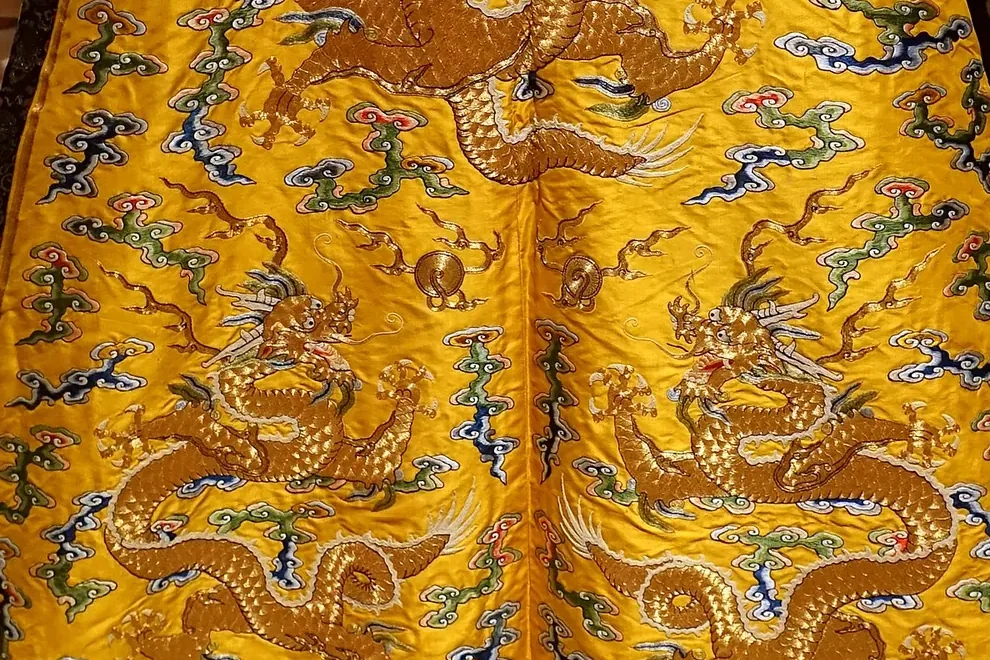
Su embroidery is traditionally judged by eight qualities: flat, neat, fine, dense, even, smooth, harmonious and lustrous. They are worth knowing because they give you something to look for beyond “pretty”.
- Flat — the stitched surface lies level, without ridges or lumps.
- Neat — edges, outlines and colour changes are clean.
- Fine — the silk floss is split thin, sometimes almost invisibly so.
- Dense — the stitches pack closely enough to build solid colour and texture.
- Even — stitch length and tension are consistent without looking mechanical.
- Smooth — the direction of the threads follows the form, so light moves across it.
- Harmonious — the colours are balanced, with no note shouting over the others.
- Lustrous — the silk carries a soft sheen, not a plastic glare.
Harmony is the hardest quality to fake. A piece can be technically competent and still look vulgar: too many colours, too much gold, a subject chosen for its price rather than its beauty. The Suzhou standard is closer to a scholar’s painting than to a souvenir stall.
The names worth knowing
Shen Shou (1874–1921) is the central modern figure. Born in Suzhou, she developed what became known as simulation embroidery: a way of using stitch direction, shading and extremely fine floss to imitate the light and texture of painting and photography. Her portrait work won awards at Turin in 1911 and at the Panama-Pacific International Exposition in 1915. Dictated from her sickbed and edited by the industrialist Zhang Jian, the Xueyi Embroidery Manual was published in 1919, two years before her death, and is still cited for its stitch taxonomy.
Yang Shouyu (1896–1981) is associated with random stitch, developed in the 1920s in Danyang, in today’s Jiangsu. Instead of parallel rows, the embroiderer crosses stitches at varying angles to mimic brushwork and impressionist colour. It began outside Suzhou’s main lineage but was adopted by Suzhou embroiderers and is now treated as one of the tradition’s major techniques.
The Suzhou Embroidery Research Institute, formed in the 1950s and still based at the Huanxiu Villa garden, is the institution most associated with the modern revival. Its embroiderers developed and refined the double-sided techniques that most visitors now think of as the signature of Su work. The institute is still the best place to see serious pieces and watch people work.
What it is not
Su embroidery is not cross-stitch, and it is not the same thing as Suzhou silk. Silk is the material; embroidery is the labour. It is also not every “silk painting” sold in the old town. Many of those are printed on silk, or machine-embroidered, or a small hand-finished detail on a machine ground. That does not make them worthless, but it makes the label misleading.
The craft is still alive, but the numbers are misleading. Thousands of people in the Suzhou area can embroider; far fewer can design a piece, split a thread to the necessary fineness, and carry a complex work from drawing to finished face. When someone says “handmade”, the useful question is not whether hands touched it. It is how much of the thinking and the stitching those hands did.
Questions people ask
Is Su embroidery the same as Suzhou embroidery?
Yes. Su xiu means Su embroidery, the tradition centred on Suzhou and the Jiangnan region. The English terms are used interchangeably.
Is Su embroidery UNESCO-listed?
No. It was added to China’s national intangible cultural heritage list in 2006. It is not on the UNESCO list, although Suzhou’s Kunqu opera is.
How old is Su embroidery?
The tradition is usually dated back more than two thousand years, with a clear artistic flowering in the Song dynasty and a peak in the Ming and Qing.
What is simulation embroidery?
A technique developed by Shen Shou in the early twentieth century. It uses fine floss, shading and stitch direction to imitate the light and texture of painting or photography.