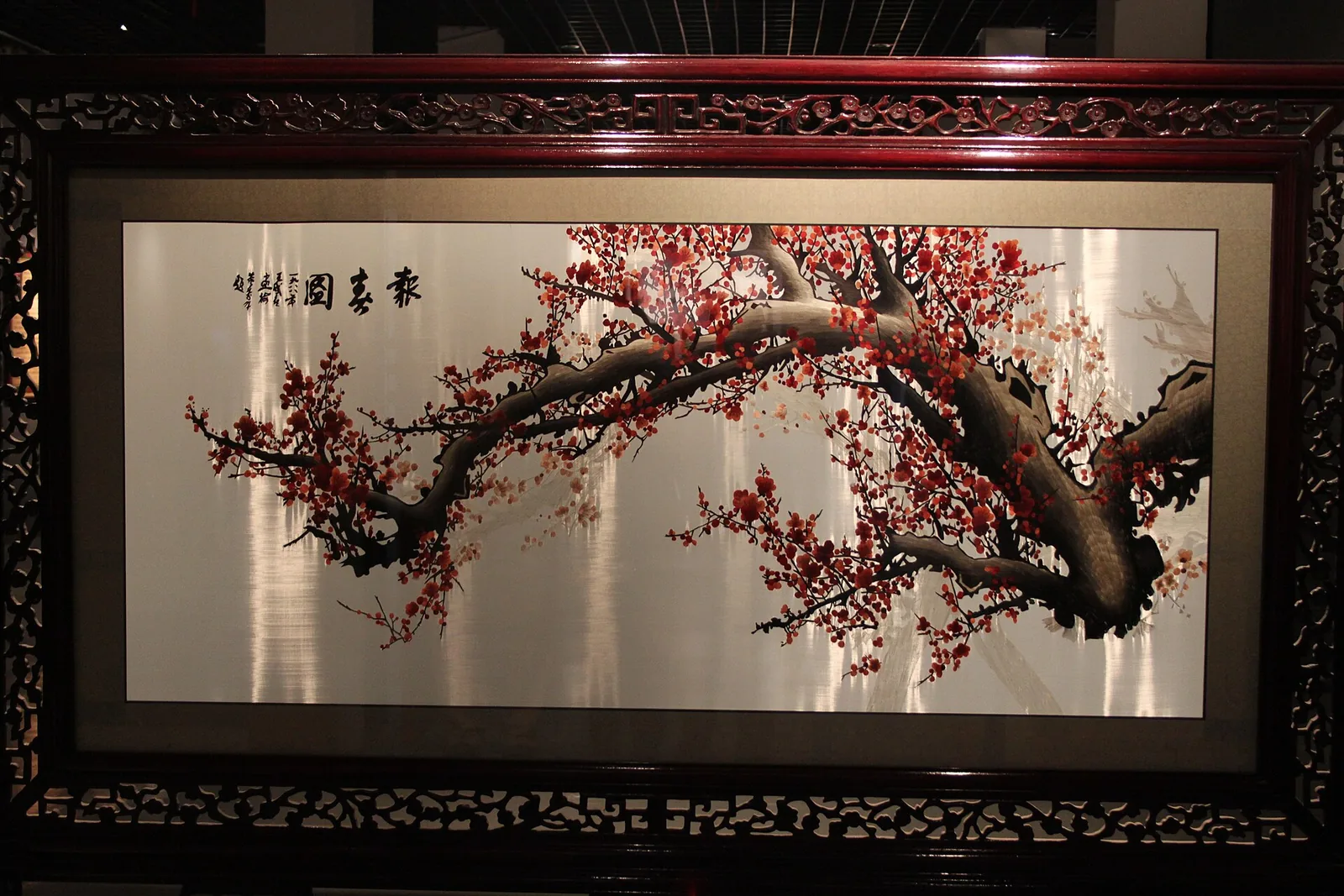
“Suzhou embroidery” is a description of a tradition, not a guarantee of method. The market contains hand-embroidered pieces, machine-embroidered pieces, printed silk with a little hand detailing, and fully printed “silk paintings”. All of them can be sold with the same words. The good news is that the differences are usually visible within a minute, if you know what to do.
The ten tests
Work through these in order. You rarely need all ten; the first three settle most questions.
- The back. Turn the piece over. Hand work has a clean reverse with thread ends buried or finished; no knots, glue, backing paper or stiff interfacing. Machine work often has a stabiliser, a glued backing or a visible grid.
- The light. Hold it up to a window. A hand piece glows unevenly in a natural way, with the density of the stitching visible. A printed base shows a flat image beneath the threads; knots and glue show as shadows.
- The surface. Look across the piece at a low angle. Hand stitching has a slight dimensional quality, with individual threads catching light. Machine work is flatter and more uniform; printed work has no thread texture at all.
- The variation. Hand stitches vary slightly in length, tension and direction. Machine stitches are identical. Perfect uniformity is a warning sign, not a virtue.
- The direction. In hand work, the stitch direction follows the form: fur flows, petals curve, water ripples. Machine work often runs in a single optimal angle across the whole shape.
- The edge. Hand-finished pieces are usually bound or wrapped in silk. Machine pieces are cut and sealed, sometimes with a visible synthetic edge.
- The density. Hand embroiderers can pack stitches densely in small areas and leave others light. Machine work tends to be evenly dense, because the machine does not know where the eye wants relief.
- The mounting. Hand work is often mounted with silk or an acid-free board; machine work is frequently glued to cardboard or foam core. Ask what is behind the frame.
- The story. Ask who made it, how long it took, and which technique was used. A specific answer is encouraging; a fluent sales story about “the master” is not proof.
- The price. Hand work is priced by time. If a large, detailed piece costs less than a meal for two, it is not hand work, however charming the seller.
The three products
| Type | Surface | Reverse | Price |
|---|---|---|---|
| Hand embroidery | Slight relief, directional sheen, small variation | Clean, no glue, buried ends | High; set by time |
| Machine embroidery | Uniform, flatter, sometimes stiff | Stabiliser or backing visible | Low to moderate |
| Printed “silk painting” | Flat image, no thread texture | Paper or board backing | Low; sold as decor |
None of these is evil. A machine-embroidered piece can be a perfectly good decorative object, and a printed silk scarf can be beautiful. The problem is paying hand-work prices for machine work, or being told a printed panel is “traditional Su embroidery”. The label should match the object.
The common scams
The oldest is the “silk painting”: a printed image on silk, framed under glass, sold as embroidery. If you cannot see thread texture, it is not embroidery. The second is the “handmade” machine piece, often with a certificate. Certificates are easy to print; the back is not. The third is the “double-sided” piece that is two single-sided panels stitched back to back. Look at the edge: a genuine double-sided piece has one cloth, not two.
The fourth is the factory tour. A demonstration of one artisan at a frame, followed by a hard sell in a showroom, is a sales format, not a studio visit. The work may be real; the prices are usually inflated to cover the commission. The fifth is the “master’s piece” with no name, no provenance and no documentation. A real master’s work usually has a name, a history and a price that reflects it.
One last test: look at the piece from two metres away, then from twenty centimetres. Good embroidery works at both distances. The composition should hold from across the room; the stitching should reward a closer look. If it only works in a photograph, it is probably decor, not art.
Questions people ask
How can I tell if Su embroidery is hand-made?
Turn it over and look at the back, hold it to the light, and examine the edge. Hand work has a clean reverse, slight variation in the stitches, and a price that reflects the hours. Machine work is uniform and often has a stabiliser or glued backing.
Is machine embroidery always bad?
No. It can be well designed and honestly priced. The problem is only when machine work is sold as hand work, or when a printed panel is sold as embroidery.
How much should hand-embroidered Su work cost?
It depends on size, density and the maker. Small hand pieces can start in the low hundreds of CNY; serious framed panels run into the thousands; double-sided screens can be tens of thousands. A large, detailed piece at a very low price is not hand work.
Do certificates prove authenticity?
Not on their own. Certificates are easy to produce. The object, the reverse and the maker’s history are stronger evidence. Buy from a museum, a known studio or a maker you can meet.