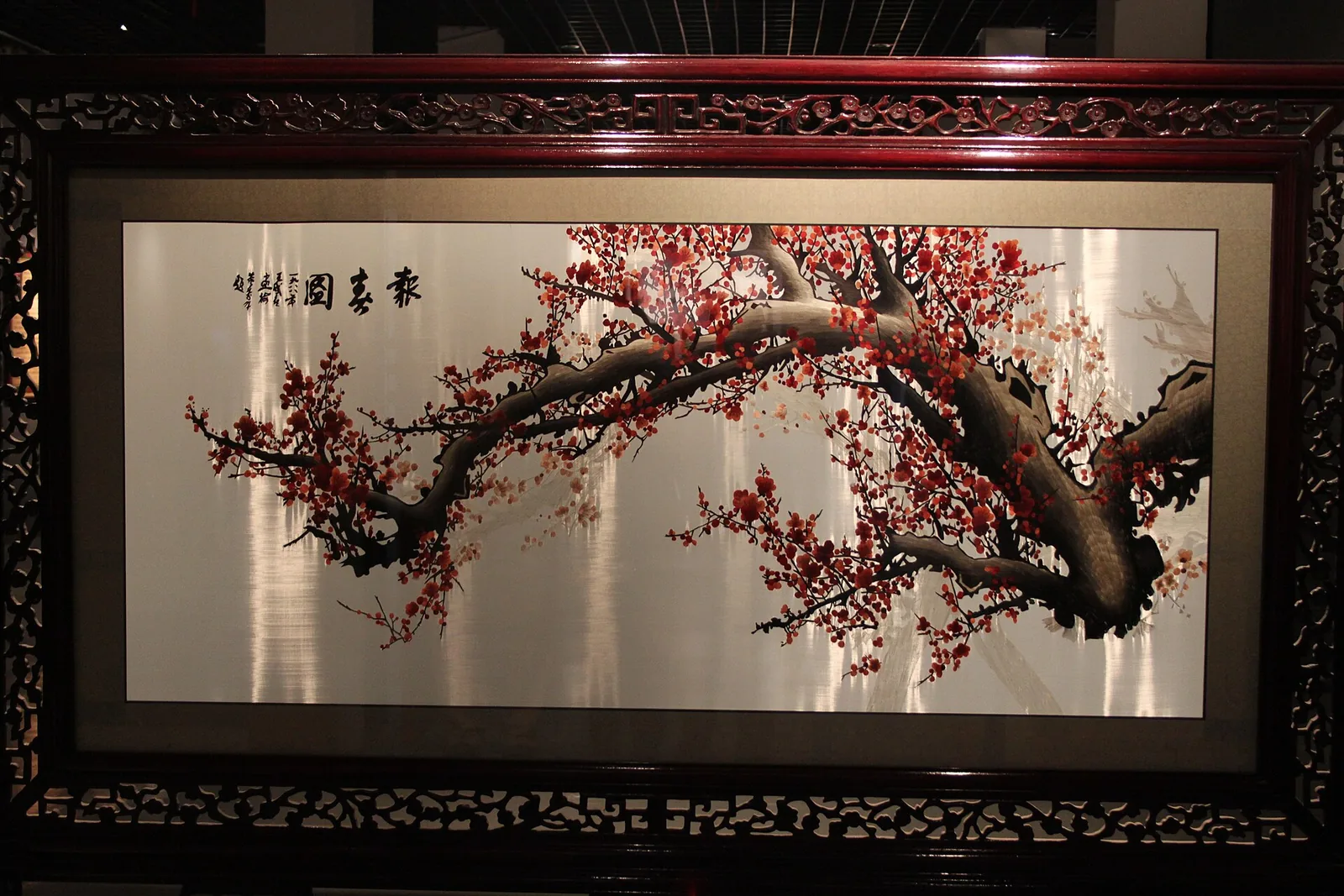
Double-sided embroidery is the image most people carry of Su work: a silk screen standing in a room, with a cat stitched on one side and the same cat — or a different animal entirely — on the other. Both faces are finished. There is no backing, no glued support, no hidden knots. The cloth is the picture, from both directions.
The basic version is difficult enough. The embroiderer must start and end threads without knots, carry colours across the work without shadows, and keep the tension even enough that neither face puckers. The advanced versions are a form of intellectual showing off: the same piece of silk carries different colour schemes, different stitch languages, or different images altogether.
The three levels
The first level is ordinary double-sided embroidery: the same design on both faces, usually in the same colours. The second is double-sided embroidery with different colours: a peony that is pink on one side and white on the other, or a fish that changes from gold to silver. The third is the “three differences” piece: different pattern, different colour and different stitch on each face. A cat on one side, a dog on the other, worked in different techniques, is the classic demonstration.
| Type | What changes | What it demands |
|---|---|---|
| Same image | Nothing | Clean reverse and even tension |
| Different colour | Palette | Two colour plans in one cloth |
| Three differences | Pattern, colour and stitch | Two complete designs sharing one ground |
The Suzhou Embroidery Research Institute is closely associated with the development of these variants in the second half of the twentieth century. The institute’s embroiderers turned a craft technique into a display of mastery, and the pieces became diplomatic gifts and museum objects. That history is why “double-sided” is still the phrase sellers reach for, even when the piece is nothing of the kind.
How it is actually worked
The embroiderer works on a silk ground stretched tight enough to behave like a drum. The design is planned so that the paths of the threads can serve both faces. Starts and ends are buried inside the stitching rather than knotted. Where colours change, the transition is built up in layers fine enough that neither side shows a step. At the edges, the finishing is as important as the centre: a sloppy edge gives away a piece that looks perfect under glass.
For the three-differences pieces, the planning is the hardest part. The two images must share the same cloth without sharing a silhouette. The embroiderer has to think in two pictures at once, deciding where one design can borrow thread or colour from the other and where the divergence must be hidden. It is closer to composing a double exposure than to following a pattern.
How to judge one
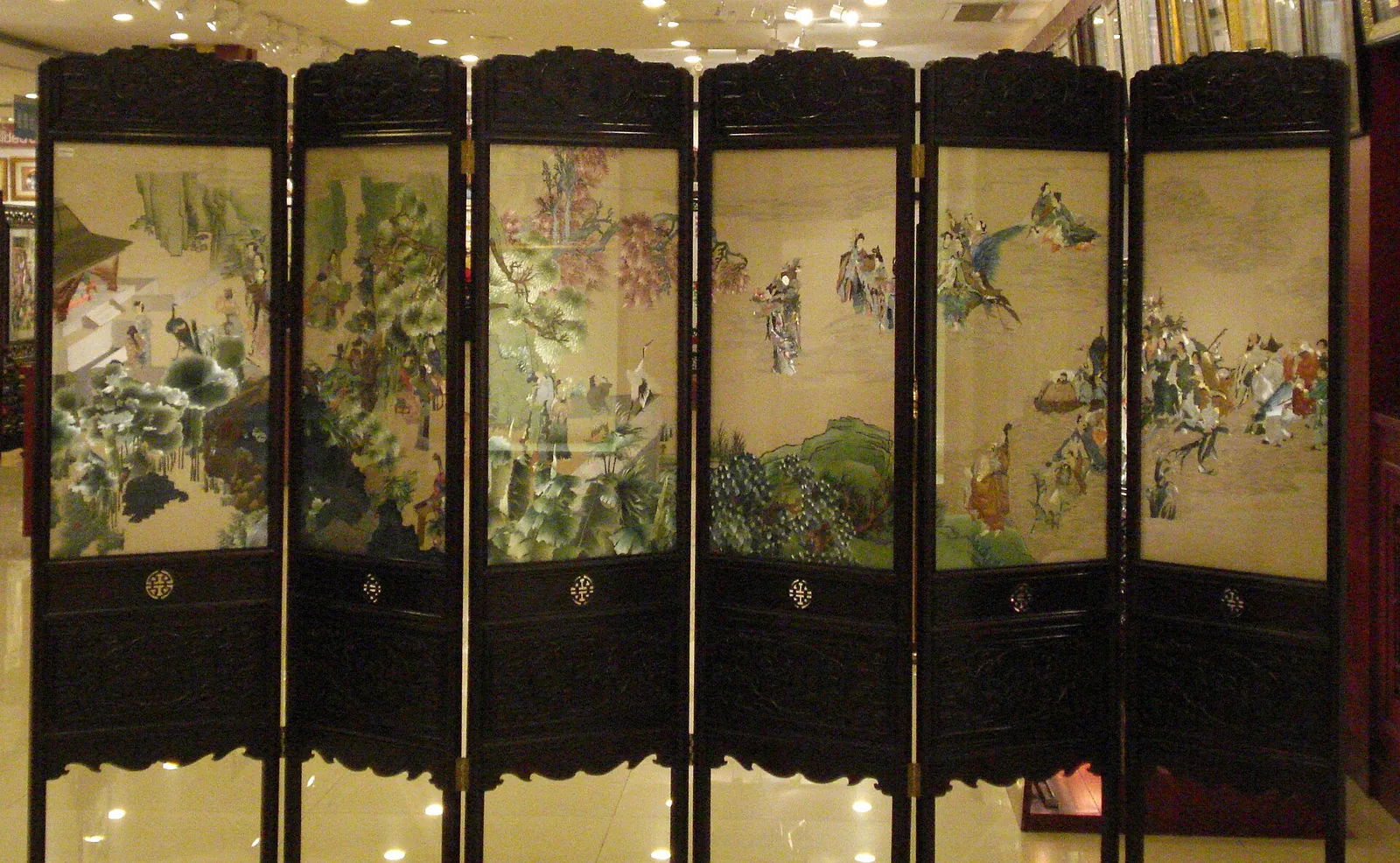
First, look at the object, not the label. A genuine double-sided screen should be mounted so that both faces can be seen: a table screen that rotates, a hanging panel with open edges, a frame with glass on both sides. If the piece is sealed against a backing board, you are not looking at double-sided work, whatever the certificate says.
Second, use light. Hold a small piece up to a window, or ask the seller to light it from behind. Knots, glue, backing paper and uneven layers show as shadows. A clean piece glows evenly. Third, look at the edge. Hand-finished edges are usually wrapped or bound with silk; machine pieces are cut and sealed. Fourth, ask how long it took. A vague answer is not proof of fraud, but a specific one — months, a year, a named technique — is a good sign.
- Both faces are fully finished, not just the front.
- No knots, glue, backing board or printed outline is visible.
- The tension is even; the silk does not pucker or sag.
- The edges are finished by hand, with no raw cut.
- The mounting allows both sides to be seen.
- The price reflects months of work, not an afternoon of machine time.
Where to see the real thing: the Suzhou Embroidery Research Institute, the craft gallery at the Suzhou Museum West Branch, and the better studios in Zhenhu. Museum pieces are usually displayed in cases, so you cannot inspect the reverse; ask a curator or guide if you are curious. In a studio, you can often see the frame, the threads and the half-finished work, which is more instructive than any label.
Questions people ask
What is double-sided embroidery?
A piece worked on a single silk ground so that both faces are finished, with no knots, backing or glued support. The most advanced versions show different images, colours or stitches on each side.
What are the “three differences”?
A double-sided piece where the pattern, colour and stitch technique all differ between the two faces. It is the most demanding form of the technique.
How can I tell if double-sided embroidery is real?
Check that both faces are finished, that the mounting lets you see both sides, and that there are no knots, glue or backing. Hold it to the light and look at the edge. If you cannot inspect the reverse, do not pay a double-sided price.
Is double-sided embroidery always expensive?
Genuine hand-worked pieces are expensive because they take months. Small pieces can be less costly than large screens, but a cheap “double-sided” souvenir is almost certainly machine-made or printed.