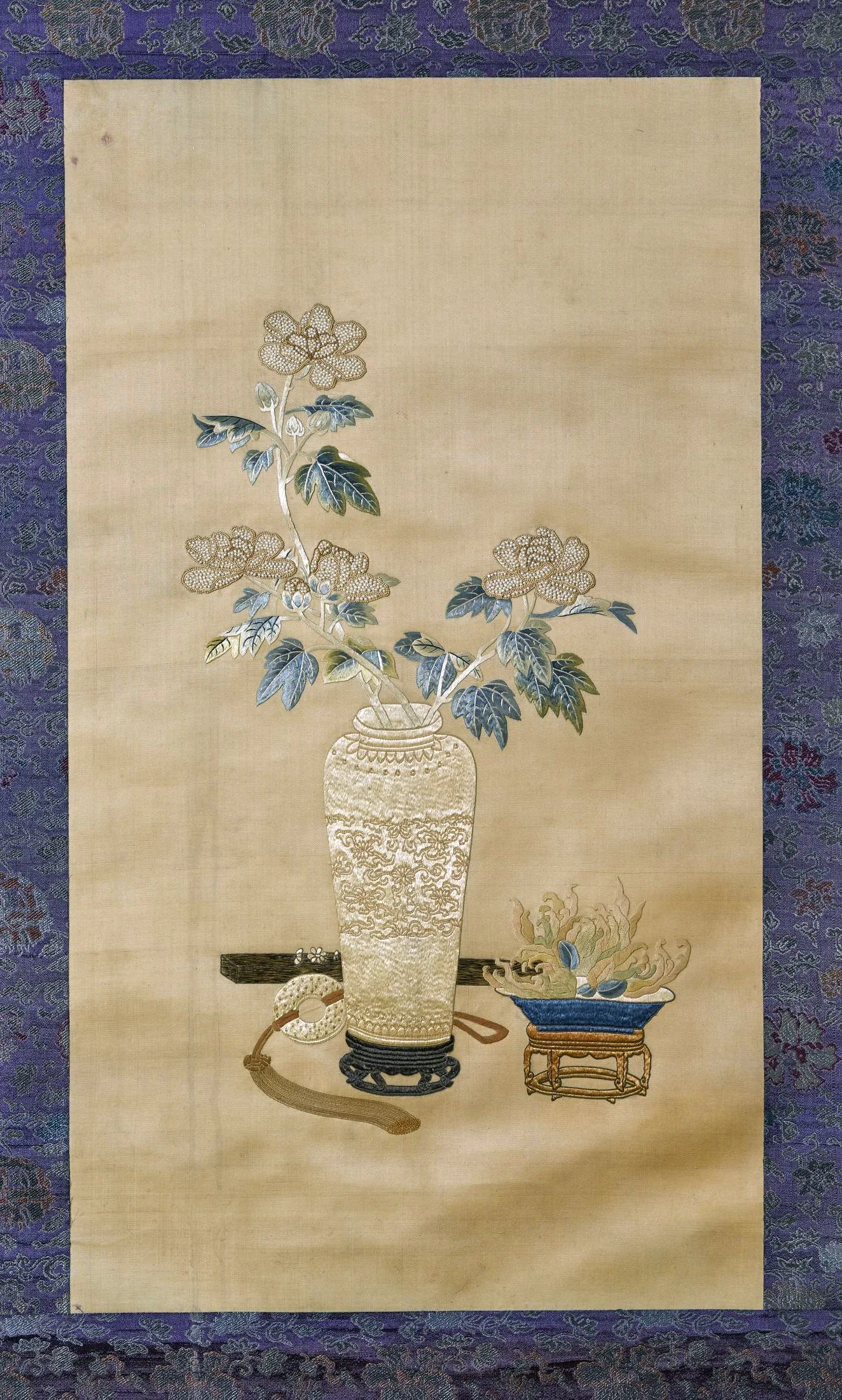
Embroidery is a language of gestures. A stitch can fill, outline, shade, texture or make light. Su embroidery uses dozens of named stitches, and different authorities count them differently, but most of what you see in a serious piece comes from a handful of families. The names are useful because sellers use them, and because they tell you what to look for.
The stitch atlas
These are the techniques that explain most of the surface. The diagrams are schematic: they show the path of the thread, not the exact scale. In real work, a single centimetre may contain dozens of stitches.
Even, parallel silk floss laid edge to edge. It is the base of most pictorial work and the ground for shading.
Look for: Lines follow the form, not a fixed machine angle. Tension varies slightly with the hand.
Closely packed stitches create a solid, reflective surface for petals, feathers and robes.
Look for: A slight cushion where threads cross, and a sheen that changes as you move.
Rows interlock so colours graduate without a visible seam. It is the technique that makes silk read as paint.
Look for: Tilt the piece: colour changes in steps fine enough to blur into one another.
Tiny knots make buds, stamens, moss, fur and the rough surface of rock.
Look for: Each knot is a small bead with a shadow. Machine dots tend to be uniform and flat.
Crossed, varied stitches imitate brushwork and impressionist light rather than parallel rows.
Look for: The surface looks drawn rather than combed; direction changes constantly.
A gold or silver cord is laid on the surface and tacked down with fine silk stitches.
Look for: The cord sits proud of the cloth. The tacks are almost invisible until you look closely.
One cloth, two finished faces, with no knots, backing or glued support.
Look for: The reverse is clean enough to display. Hold it to the light and look for shadows.
Two faces with different pattern, colour and stitch language in a single piece.
Look for: The two images do not share a silhouette. The edges hide the crossover.
What the names mean in practice
A gallery label may say “flat stitch”, “tao stitch” or “random stitch” without explaining anything. What matters is the effect. Flat and satin stitches build form. Tao stitch builds colour transitions. Seed stitch builds texture. Random stitch builds atmosphere. Gold couching builds ceremony. Double-sided work builds a performance.
| What you see | Likely technique | What it tells you |
|---|---|---|
| Smooth areas of colour | Flat or satin stitch | The foundation of the piece |
| Soft gradients | Layered tao stitch | Time and planning |
| Tiny raised dots | Seed stitch | Texture, often in flowers or fur |
| Painterly, angled strokes | Random stitch | A more modern, pictorial approach |
| Raised metallic lines | Gold couching | Ceremonial or decorative intent |
| Two clean faces | Double-sided construction | High skill and high price |
Thread: the invisible variable
The fineness of the floss matters as much as the stitch. A single strand of silk can be split into many thinner filaments; the finest work uses filaments that are barely visible against the ground. This is why hand work can look smoother than machine work, and why it takes so long. The embroiderer is not just placing stitches; she is controlling how much light each thread catches.
Colour is built the same way. A leaf may use a dozen greens; a cat’s fur may use dozens of greys and browns. The palette is usually sorted before the work begins, because stopping to mix a new shade breaks the rhythm. When you see a box of numbered silk bobbins beside a frame, you are looking at the first draft of the picture.
You do not need to identify every stitch to enjoy the work. But knowing four things — flat, tao, seed and random — will let you read most labels and most shop claims. The rest is detail, and the detail is where the pleasure lives.
Questions people ask
How many stitches does Su embroidery use?
Different sources count dozens. Shen Shou’s manual organised eighteen stitch types; modern references subdivide them further. Most pieces rely on a small core of flat, satin, layered, seed and random stitches.
Which stitch is most characteristic of Su embroidery?
Layered tao stitch is the one most associated with its shading, and double-sided construction is its most famous display of skill. Flat stitch is the foundation underneath both.
What is the difference between flat stitch and satin stitch?
Both use parallel stitches. Flat stitch is the general technique of laying even stitches across a shape; satin stitch packs them tightly to create a solid, reflective fill. The terms overlap in casual use.