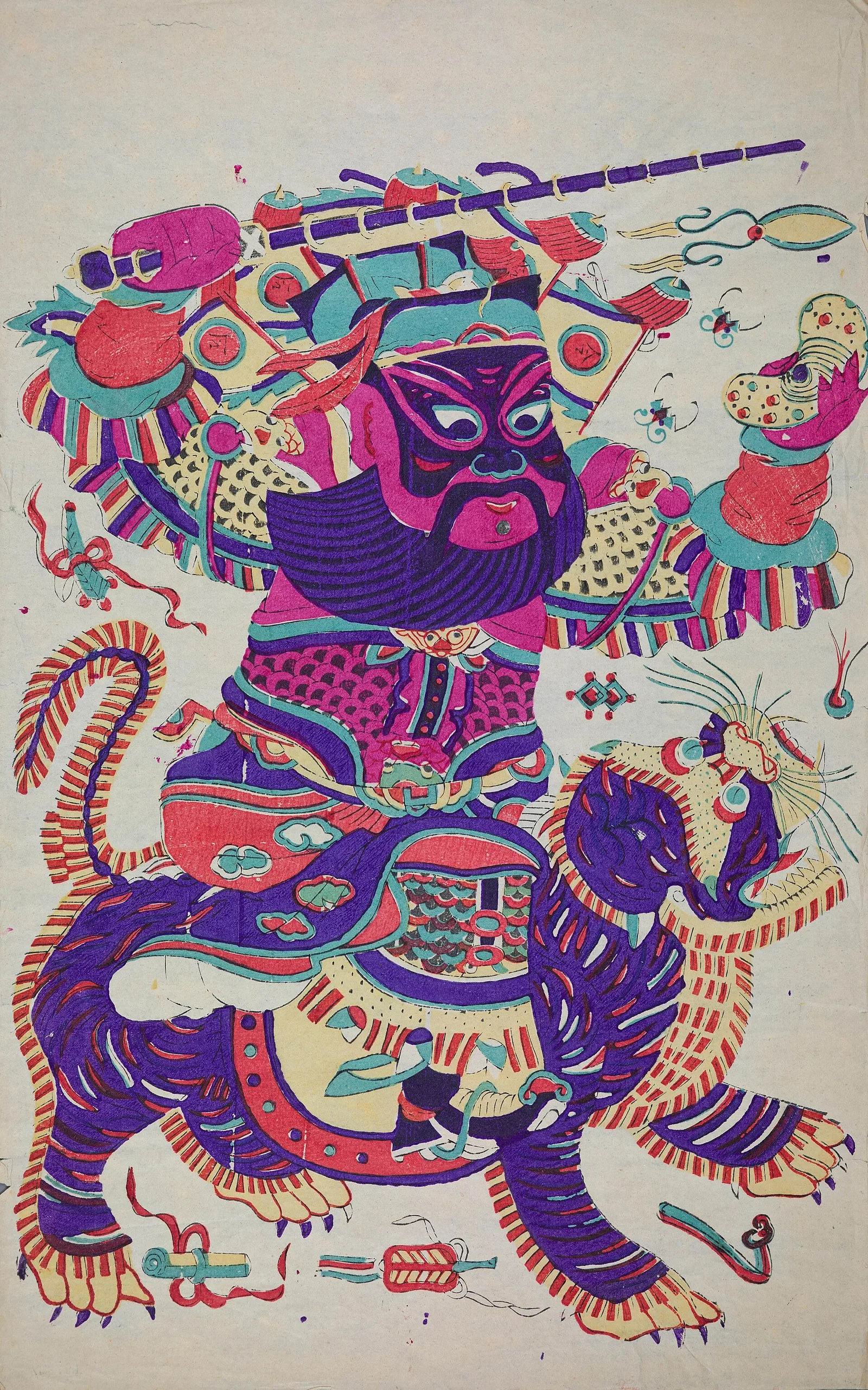
Taohuawu is a neighbourhood in north Suzhou, and for more than four centuries it has given its name to a style of woodblock New Year print. These were household objects, pasted on doors at the new year to invite good fortune and keep bad luck out. They are one of the city’s most underrated arts.
The prints are bold, flat and colourful, with a visual language that owes more to opera and folk religion than to literati painting. Door gods glare from the page. A plump child holds a carp. A bat flutters above a peony. Every image is a pun, a blessing or a threat. Once you learn the code, the prints are endlessly readable.
What actually happens
We start with the prints themselves: door gods, the kitchen god, auspicious children, opera scenes. I will explain the visual code — the bat, the fish, the vase, the pomegranate — so that a crowded print becomes readable. Then we go into the workshop.
The printer shows you the blocks, the ink, the paper and the registration. You will carve a simple design or prepare an existing block, ink it, place the paper and print. The first print is usually uneven. The second is better. You will make a small edition to take home.
The session ends with a look at modern limited prints and a short discussion of how to tell an original from a reproduction. There is no obligation to buy anything beyond the print you made.
Why it is a good counterweight
The gardens and the scholar’s arts are elite culture. Taohuawu prints are the other Suzhou: popular, commercial, funny and sometimes violent. They show the city’s visual imagination outside the studio. If you have spent the morning in a garden, this is a good way to spend the afternoon.
The craft was added to China’s first national intangible cultural heritage list in 2006. It survives through a small number of inheritors, museums and workshops. A printing session is a good way to understand the process even if you do not buy anything.
Who it is for
It suits families with older children, travellers who like making things, and anyone who wants a break from looking. It does not suit anyone who wants a fine-art printmaking course; this is an introduction to a folk tradition.
What is included
- Workshop time with a Taohuawu printer.
- All materials for carving, inking and printing.
- A short introduction to the symbolism.
- English interpretation, tea, and the prints you make.
Not included: hotel, transport, meals, and any additional prints or antiques you choose to buy.
A note on price
The workshop is quoted per group. Materials and the printer’s time are the main costs. I confirm the quote and the cancellation terms before you commit.
How to arrange it
Tell me your dates, group size and whether you want to carve or print. I will check the workshop calendar and reply with a shape and a quote. Two weeks’ notice is usual; longer in the run-up to Chinese New Year.
Questions people ask
Can children do it?
Older children can print and help carve under supervision. The tools are sharp, so the age limit depends on the workshop.
Will I take a print home?
Yes. You will make a small edition. The ink needs time to dry; the workshop will pack it for travel.
Is this suitable for a rainy day?
Yes. It is indoor, hands-on and central. It works well as a rainy-afternoon alternative to a garden.
Can I buy an original print?
You can ask. I do not take a commission, and I will help you distinguish an original woodblock print from a reproduction.