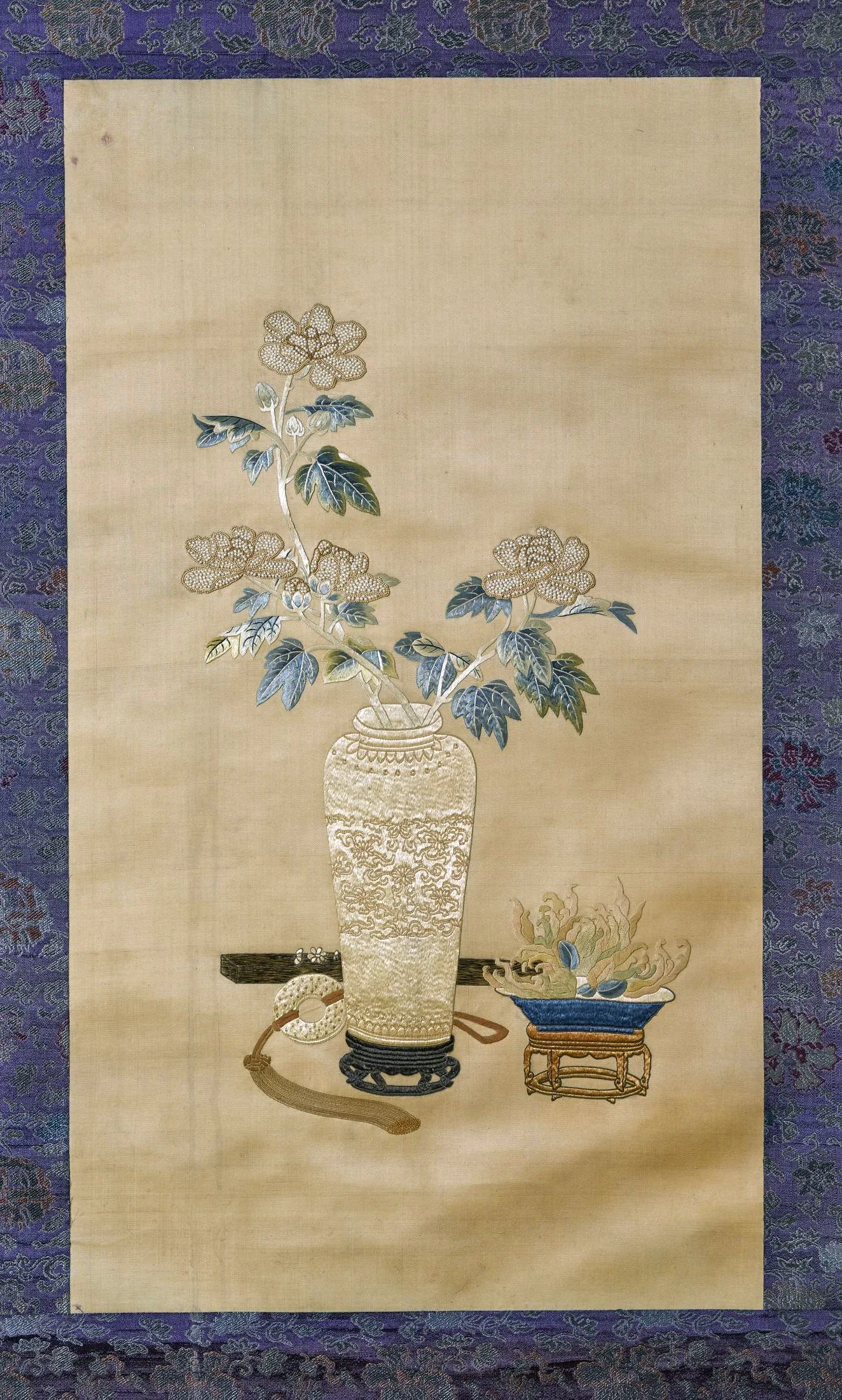
Most visitors meet Su embroidery on Pingjiang Road, framed and shrink-wrapped, sold with a story. The real thing is quieter: a room with north light, a wooden frame, a reference drawing, and a person who has been working the same leaf for a week. This experience puts you in that room.
Su embroidery is one of China’s four great embroidery traditions and the one most closely associated with refinement. The craft’s eight qualities — flat, neat, fine, dense, even, smooth, harmonious and lustrous — describe a standard that is easy to state and hard to meet. Seeing the work in progress is the fastest way to understand why.
What actually happens
We start with a short, focused look at real pieces, either in a museum collection or in the studio’s own archive, depending on the day. I will show you the difference between flat stitch, satin stitch and the layered shading that makes Su work look like painting. Then we move to the working studio.
The artist shows you how silk floss is split, how the needle is held, and how the back of the work is finished. You will sit at a practice frame and try a few stitches. The first attempt is usually bad. That is the point: it makes the finished pieces legible.
The afternoon is flexible. You can stay at the frame, look at the studio’s current work, or talk about how a piece is designed, priced and sold. There is no obligation to buy. If you do want to buy, I will help you ask the right questions about technique, time and provenance.
Half day or full day
The half-day version is four hours: collection or studio archive, studio visit, and a short practice session. It suits travellers who are in Suzhou for two or three days and want one deep craft encounter.
The full day adds a second studio or the Silk Museum, a longer practice session, and lunch with the artist or the studio team. It suits anyone who wants to understand the material from mulberry worm to finished panel. The full day is also the better choice for a family with older children.
Who it is for
It suits travellers who are curious about process, comfortable sitting quietly, and happy to try something with their hands. It suits collectors who want to understand what they are looking at. It does not suit anyone who wants a quick demonstration and a shopping stop, or a young child who needs constant movement.
What is included
- Studio time with a practising Su embroidery artist.
- English interpretation throughout the session.
- All materials for the practice session.
- Entrance to the museum or archive where relevant.
- Tea and water, and a short reading list before you arrive.
Not included: hotel, transport, lunch on the half-day version, and any work you choose to buy. I do not take a commission on purchases. If you buy a piece, you pay the studio directly.
A note on price
The experience is quoted per group. Artist time is the main cost, and a working studio cannot absorb a crowd. That is why the group is capped at six. I confirm the quote and the cancellation terms in writing before you commit.
How to arrange it
Tell me your dates, group size and whether you want the half or full day. I will check the studio calendar and reply with a shape and a quote. Two weeks’ notice is usual; longer is better in spring and autumn.
Questions people ask
Can I try double-sided embroidery?
You can see it and understand the principle. A first lesson is usually single-sided: double-sided work requires a control that takes months to build.
Is it suitable for children?
Older children who can sit and concentrate for an hour usually enjoy it. The studio is a working environment, so very young children are not a good fit.
Can I buy a piece?
Yes, if the studio has work for sale. I do not take a commission, and I will help you ask about technique, time and price. Buying is entirely optional.
Do I need to speak Chinese?
No. The session is interpreted in English, and the artist demonstrates as much as explains.