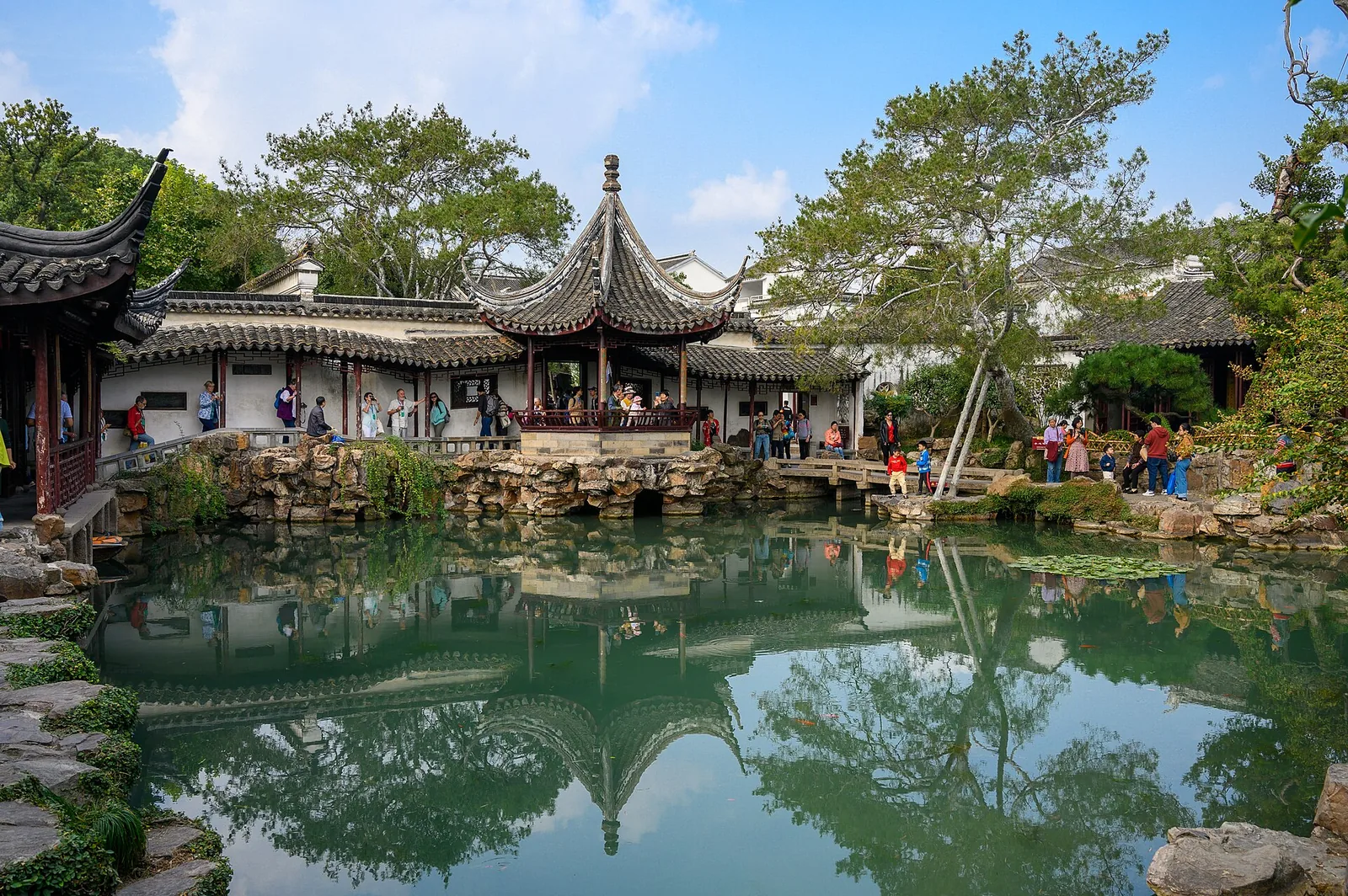
The Master of the Nets Garden is the smallest of the famous four, and the one that feels most like a home. That is not an accident. It began as a Song dynasty residence, was rebuilt in the Qing, and retains the proportions of a private house: a few halls, a courtyard, a pond, a pavilion, and a wall that keeps the world out. You can walk across it in a minute. You can spend an hour looking at it.
The name comes from a line about a fisherman’s net, a scholar’s retirement, and the pleasure of a simple life. The garden is not simple. It is extremely controlled. But the fiction is part of the charm: a small world pretending to be enough.
Why the scale matters
At the Humble Administrator’s, you are always aware of the size of the place. At the Master of the Nets, you are aware of the size of the room. The windows are lower, the doorways narrower, the pond closer. A single branch of a tree can fill a frame. A single rock can be the mountain. The garden asks you to look at less, more closely.
This is why it is a good second garden. After you understand the vocabulary, the small garden becomes a masterclass in editing. There is no room for a weak view. Every corner is doing something.
The route
- Enter through the residential halls. The sequence of rooms is dark and quiet. Notice how the garden appears through doorways before you reach it.
- Step into the courtyard. The pond is small, the pavilions are close, and the wall is high. This is the whole garden in one view.
- Walk the covered corridor along the wall. It lifts you slightly above the water and gives you a new angle on the pavilions.
- Sit in the pavilion at the far end. Look back at the house. The garden is designed to be seen from here, and the house is part of the composition.
- Climb to the upper pavilion if it is open. The view over the wall is a borrowed view of roofs and trees. It is the only place where the garden admits there is a city outside.
The evening performance
The Master of the Nets runs an evening garden performance with short scenes of Kunqu, Pingtan, flute, and dance placed around the garden. It is a tourist-oriented format, and the crowd can be large, but the setting is genuinely magical: lanterns, water, and music in a small garden after dark. If you want atmosphere rather than authenticity, it is worth the ticket. If you want serious opera, go to a proper Kunqu theatre instead.
When to go
Late afternoon is the best daytime window: the tour groups have thinned, the light is soft, and the garden is small enough to see in 45 minutes. Opening is also quiet, but the garden can feel a little dark before the sun is fully up. Avoid midday, when the courtyards are crowded and the water reflects the sky flatly.
The garden is in the south-east of the old town, near the Suzhou Hotel and a short taxi ride from Pingjiang Road. It pairs well with a late lunch and an early evening walk along the canal.
Who it suits
Couples, solo travellers, photographers interested in small compositions, and anyone who wants a garden without a two-hour commitment. It is also the best garden for a rainy late afternoon, when the courtyards are empty and the sound of water fills the space.
It does not suit families with energetic children, who will be through it in ten minutes and bored. It also does not suit anyone looking for the grandeur of the Humble Administrator’s. This is a garden of small things.
Questions people ask
Is the Master of the Nets worth the ticket?
Yes, if you value intimacy and design over size. It is the most expensive garden per hectare in Suzhou, but it is also the most perfectly composed. Allow 45 minutes and go late.
Should I see the evening performance?
If you want atmosphere and music in a lantern-lit garden, yes. If you want serious Kunqu, see a full performance at a theatre. The evening show is a tasting menu, not a full meal.
How does it compare with the Humble Administrator’s Garden?
It is the opposite experience: tiny, quiet, domestic and precise. See it second, after you have learned the vocabulary at a larger garden.